
Aspects in Astrology
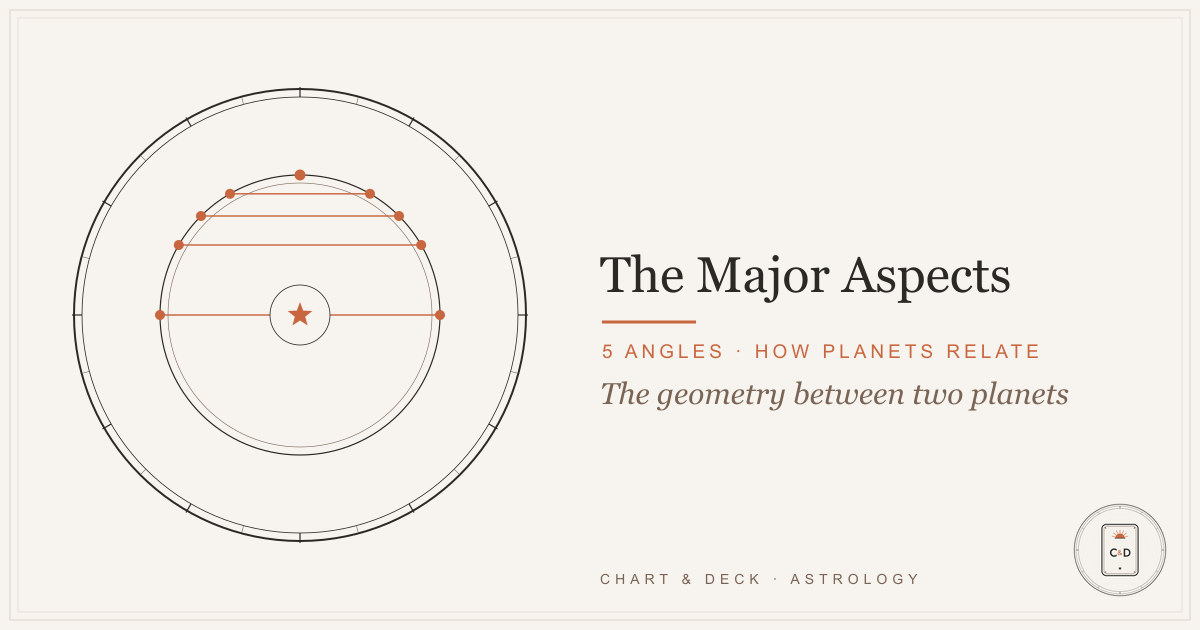
Two planets can sit anywhere on your chart wheel, but only a handful of angles between them actually mean something. Those angles are aspects in astrology, and they are the reason a chart reads like a person instead of a list of traits: they show whether two of your drives work together easily, pull against each other, or blend into one loud voice. If the planets are what is happening in you and the signs and houses are the style and the setting, the aspects are the relationships, the conversations running between your drives.
Here is what an aspect is, the five that matter most, why a “hard” one is not bad news, and a link to the full guide for each.
On this page
What an aspect actually is
An aspect is a specific angle between two planets, measured around the 360 degrees of the chart wheel. When two planets sit at one of a handful of meaningful angles, astrology reads them as connected, as if the two drives can feel each other.
The planets are the drives themselves. The aspect is how any two of them get along. Two planets in a smooth aspect tend to cooperate without you thinking about it. Two in a tense aspect tend to argue, which sounds like a problem and is often the opposite, as you will see.
Aspects are the fourth layer of a chart. The planet is what, the sign is how, the house is where, and the aspect is how your drives talk to one another. Read one planet at a time and you get a trait. Read the aspects and you get the inner weather.
The five major aspects
These five are the classical, or Ptolemaic, aspects, named for the astronomer Ptolemy who wrote them down in the second century. They are the simplest divisions of the circle, and they carry most of the weight in a reading.
- Conjunction: 0 degrees. Two planets in the same spot. Their drives merge and amplify each other into a single, strong theme. Neither easy nor hard on its own; the flavor depends on which two planets are fused.
- Sextile: 60 degrees. An easy opening between two drives, a talent or opportunity that is there if you reach for it. It rewards effort rather than handing anything over.
- Square: 90 degrees. Two drives pulling in different directions. It reads as friction and turning points, and it is one of the most productive angles in the whole chart.
- Trine: 120 degrees. Two drives that flow together naturally, an innate gift. Its only real risk is that it comes so easily you never develop it.
- Opposition: 180 degrees. Two drives facing each other across the chart. It works through awareness, balance, and the things you tend to notice in other people before you notice them in yourself.
Not all five are equally loud. The conjunction and opposition tend to be the most powerful, the trine and square are in the middle, and the sextile is the subtlest.
Hard and soft aspects, and why “hard” does not mean bad
You will see aspects sorted into two groups. The square and the opposition are called hard or dynamic. The trine and the sextile are called soft or harmonious. The conjunction sits in neither camp; it goes whichever way the two planets take it.
Here is the part worth being careful about. The old habit was to read hard as bad luck and soft as good fortune, and a lot of the internet still does. Modern astrology has largely dropped that, and for good reason. The psychological tradition that this brand reads from, running through Carl Jung, Liz Greene, and Richard Tarnas, treats the hard aspects as the engine of growth. Tarnas calls the hard aspects “the most fruitful” in a person’s life, producing “energetic dynamism” and a “strengthening of character.” People who achieve things of real consequence, he argues, regularly carry hard aspects between the planets most relevant to that achievement. The friction is what creates the pressure to develop.
So a chart full of trines can be gifted and a little coasting, and a chart with a tight square can be the one that builds something. Soft aspects are gifts. Hard aspects are assignments. Neither is a verdict.
What an orb is, and why astrologers disagree about it
Two planets rarely sit at exactly 90 or 120 degrees. An orb is the wiggle room, the number of degrees off-exact that still counts as an aspect. A square with a 2-degree orb is tight and loud; one with a 7-degree orb is looser and quieter.
There is no single agreed set of orbs. Different astrologers and traditions use different numbers, and that is normal, not a mistake. As a rough guide, conjunctions get the widest orbs and sextiles the narrowest, and the Sun and Moon are often given a little more room than the other planets. Treat any orb figure you see as one practitioner’s convention, not a law.
The closer to exact, the stronger the aspect. An aspect that is still tightening (applying) tends to read as building, one that is pulling apart (separating) as fading.
How aspects fit the rest of the chart
Put the layers together and a chart starts to read like a life. The planets are what is happening, the signs are the style, the houses are where it lands, and the aspects are how it all interacts. Chart tools draw the aspects as lines across the middle of the wheel, or list them in a grid called an aspectarian, so you can see at a glance which drives are in conversation.
The full method for reading them together is in how to read your birth chart.
Questions people ask about aspects
What are aspects in astrology? Aspects are the angles between planets in your birth chart. They show how two of your drives interact: easily, tensely, or fused. The five major ones are the conjunction, sextile, square, trine, and opposition.
What is the difference between hard and soft aspects? Soft aspects (trine, sextile) flow easily and feel like gifts. Hard aspects (square, opposition) create tension and tend to drive growth. The conjunction is neutral. Hard does not mean bad; in the psychological tradition it is often where the real development happens.
What is an orb in astrology? An orb is the allowable distance from the exact angle that still counts as an aspect. Orbs vary by astrologer, with conjunctions usually given the widest and sextiles the narrowest. The tighter the orb, the stronger the aspect.
Which aspect is the strongest? The conjunction and the opposition tend to be the most powerful, the trine and square are moderate, and the sextile is the subtlest. Strength also depends on how tight the orb is.
What are the minor aspects? Beyond the five major aspects there are minor ones (such as the quincunx, semisextile, and semisquare) that work at smaller angles and read more quietly. Start with the five majors; they carry most of a chart.
What are the five major aspects in astrology? The conjunction (0 degrees), sextile (60), square (90), trine (120), and opposition (180). These classical, or Ptolemaic, aspects carry most of the weight in a chart.
How do you find the aspects in a birth chart? Chart tools draw them as lines across the center of the wheel, or list them in a grid called an aspectarian. You read the two planets, the angle between them, and how tight the orb is, together.
When you want your own chart read
A guide tells you what a square or a trine means. It cannot tell you what it means that your particular planets are locked in that angle, or which conversation in your chart is running your year.
When the question shifts from “what do aspects mean” to “what is actually pulling against what in me,” a reading does what a guide cannot: a person weighs the whole configuration against your real life, one chart at a time. Start with your free Essence to see your own chart in plain language, or see the readings when you want that fuller read.
For the whole method, go back to how to read your birth chart.