
The 12 Houses in Astrology
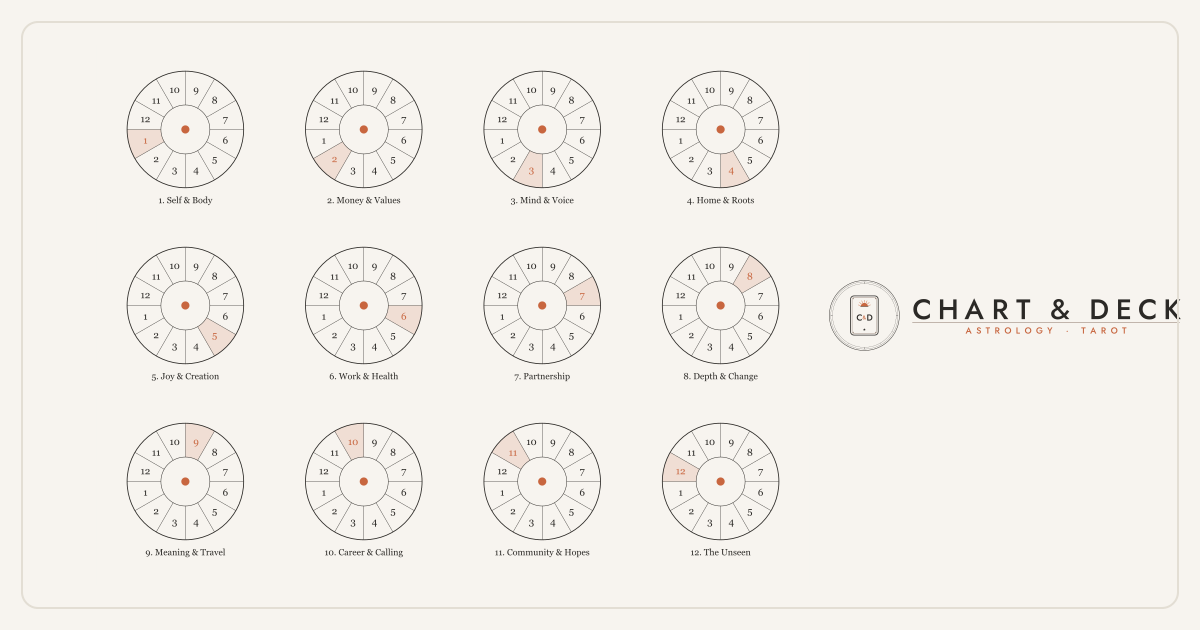
The 12 houses in astrology are the twelve areas of life your birth chart is divided into: self, money, communication, home, creativity, work, partnership, intimacy, meaning, career, community, and the inner world. If the signs describe the style of a planet and the planets describe what is happening, the houses tell you where it happens, which actual arena of your life it plays out in.
That is the piece that makes a chart personal.
A planet floating in a sign is a tendency in the abstract. Drop it into a house and it has an address: this is the part of your life where that energy lives. Here is what the houses are, how to find yours, and what each of the twelve covers.
On this page
What a house actually is
The birth chart is a wheel, and the wheel is cut into twelve slices. Those slices are the houses.
The signs are the zodiac band the wheel turns through, and the planets are the players. The houses are the twelve rooms those players move through. The order is fixed, and it tells a quiet story: it begins with the self and moves outward to the world, then inward again to what you carry privately.
The wheel starts at your Ascendant, the rising sign, the point on the eastern horizon at the moment you were born. That becomes the cusp of your 1st house, and the other eleven count forward from there. One line to keep: signs are how, planets are what, houses are where.
How to find your houses
You need your birth time. The houses are pinned to the exact moment and place you were born, because they hang off the rising sign, and the rising sign changes every couple of hours. Same birthday, different hour, different houses.
With an accurate time, your chart drops every planet into a house. Without a time, you can still read the planets and signs, but the houses stay uncertain. Start with your free Essence to see your own houses laid out, or read the full how to read your birth chart walkthrough.
The twelve houses, one by one
Each house rules an area of life. Here is the plain version of all twelve, with a link to the full guide for each.
- 1st house: self and identity. How you come across, your manner and appearance, the body, and beginnings. The face you meet the world in.
- 2nd house: money and worth. What you own, what you earn, what you value, and your sense of your own worth.
- 3rd house: mind and siblings. Communication, how you think and learn, siblings, neighbors, and the short trips of daily life.
- 4th house: home and roots. Family, the past, where you come from, and the private base everything else is built on.
- 5th house: creativity and joy. Play, self-expression, romance, children, and what you make for the love of it.
- 6th house: work and the body. Daily routines, habits, health, service, and the small upkeep that holds a life together.
- 7th house: partnership. Marriage, committed one-to-one bonds, the close other, and binding agreements.
- 8th house: intimacy and transformation. Deep bonding, shared resources, and the things that change you from the inside.
- 9th house: meaning and the horizon. Beliefs, philosophy, higher learning, long travel, and the search for what it all adds up to.
- 10th house: career and standing. Your public role, reputation, ambition, and the mark you make in the world.
- 11th house: community and the future. Friendships, groups, hopes, and the people you build the future alongside.
- 12th house: the inner world. Solitude, rest, the unconscious, what works behind the scenes, and what you set down at the end.
Houses come in groups
The wheel has architecture. The four angles, the 1st (self), the 4th (home), the 7th (partnership), and the 10th (career), are the headline houses. A planet sitting on one of these tends to be loud in your life.
The houses also fall into three rhythms: angular (1, 4, 7, 10), where things start; succedent (2, 5, 8, 11), where things build and hold; and cadent (3, 6, 9, 12), where things shift and adapt. You never need the jargon to read a chart, but it explains why some houses feel like engines and others like transitions. The wheel also has a loose arc: the first six houses lean toward your own life up close, the second six toward your life among others.
What an empty house means
Most charts have empty houses, and that is completely normal. You have ten planets and twelve houses, so at least two houses sit empty in every chart, usually more.
An empty house does not mean that part of life is missing or doomed. It means your chart does not pool its intensity there. You read the area through the sign on its cusp and the planet that rules that sign, and it still works. It simply is not where the chart puts its weight.
Questions people ask about the houses
What are the 12 houses in astrology? The twelve areas of life your birth chart is divided into, from the self (1st) through money, communication, home, creativity, work, partnership, intimacy, meaning, career, and community, to the inner world (12th). Signs describe how, planets describe what, houses describe where.
Do I need my birth time for the houses? Yes. The houses are set by your rising sign, which changes every couple of hours, so an accurate birth time is what makes them reliable. Without it you can still read signs and planets, but the houses stay uncertain.
What does an empty house mean? Nothing is wrong. Empty houses are normal; you read them through the sign on the cusp and its ruling planet. The area of life still functions, it just is not where your chart concentrates.
Which house system should I use? Most modern Western astrologers use Placidus or Whole Sign houses. They divide the wheel a little differently, and a placement can shift between houses depending on which you use. Start with whatever your chart tool gives you and do not let the debate stall you; the meanings of the houses are the same either way.
Where the houses fit
The houses are one of four layers in a birth chart. The planets are what is happening, the signs are the style, the houses are where it lands, and the aspects are how the planets talk to each other. Put the four together and the chart starts to read like a life rather than a diagram. The full method is in how to read your birth chart.
What determines the houses in my birth chart? Your exact birth time and location set the house cusps, which is why an accurate birth time is essential for reliable house placements.
Which house is the most important in astrology? No single house is most important, though the four angular houses (1st self, 4th home, 7th relationships, 10th career) are often considered especially influential.
When you want your own houses read
A guide gives you the map. It cannot tell you what it means that your particular planets fall where they do, or which house is quietly running your year.
When the question shifts from “what do the houses mean” to “what is my own chart concentrating on, and where,” a reading does what a guide cannot: a person reads the whole wheel against your real life, not a lookup table. Start with your free Essence to see your own houses in plain language, or see the readings when you want that fuller read.
For the whole method, go back to how to read your birth chart.