
Zodiac Signs
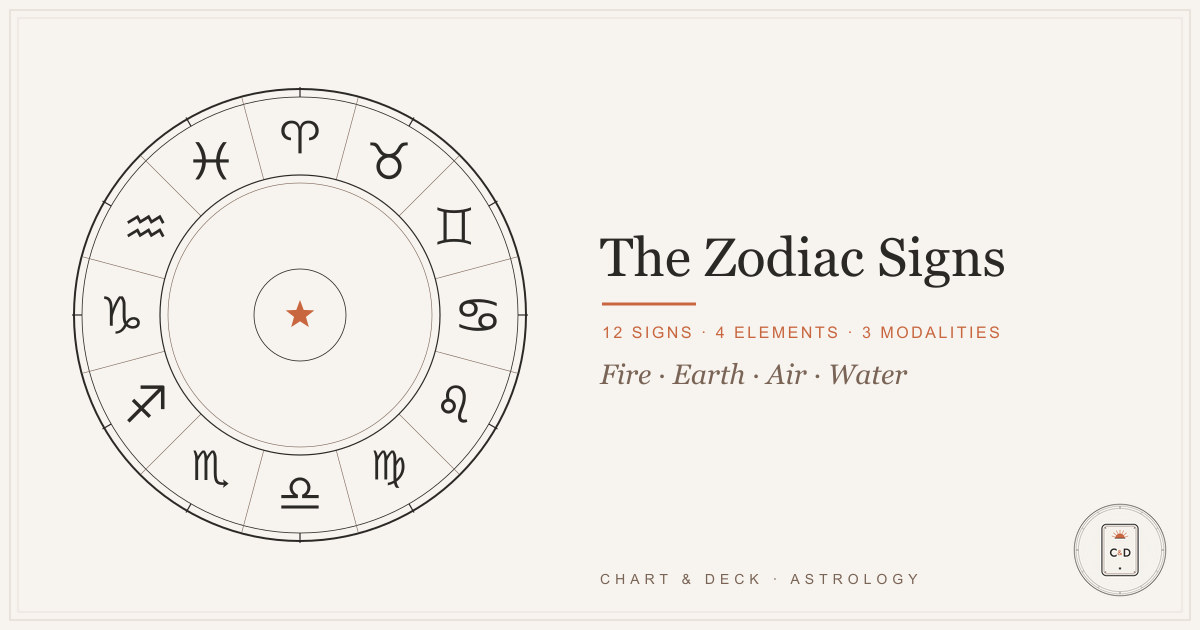
Zodiac signs are the twelve, roughly month-long divisions of the sky the Sun appears to move through over a year, and most people only ever meet them one at a time, as a single word that supposedly explains them. But a zodiac sign was never meant to stand alone. Every sign is one square in a 4×3 grid, four elements crossed with three modalities, and that grid is the reason there are exactly twelve of them and not eleven or thirteen.
Before we open the grid up, sit with one night where a single label stopped being enough.
The observation deck, 3am
The plane was still banking when Sunniva felt the old dread arrive early, a full ten minutes before the wheels would touch anything.
By the time she found the observation deck, the flight was long down and gone, one more set of taillights taxiing toward a gate. She had missed her connection by four minutes and change, and the airport hotel had given her a room with a view of the exact runway that had just finished ruining her night. She went up to the deck instead of the room, because the room had a bed in it, and beds were for people who could sleep.
Below her the runway lights ran out in two straight rows, patient, indifferent, blinking in a rhythm that had nothing to do with her. A man was already up there, elbows on the rail, watching a cargo plane get de-iced under floodlights like it was the only interesting thing happening on Earth.
“You’re the one from the gate,” he said, not turning around. “The four-minutes one.”
She had been loud about it. Fair.
“I had a whole plan,” she said. “I’m apparently a very different person when the plan holds.”
“Yeah?” He glanced over now. “Who are you when it doesn’t?”
Nobody had asked her that so plainly before. She opened her mouth for the easy answer, the one she gave at parties, the tidy one-line version of herself she’d been handing out for years. It didn’t come. What came instead was the truth, that she genuinely didn’t know, that the version of her standing on a strange rail at 3am watching someone else’s cargo plane get de-iced was not a version she’d ever had to introduce to anyone.
“I don’t think I’ve met her,” Sunniva said. “She just got here.”
The man almost smiled. “Runway’s nice at this hour. Most people never see it.”
Neither of them left for a long time.
The tidy one-line version of Sunniva, the one she handed out at parties, was not a lie. It just was not the whole chart. Every person carries more than the label on the front of them, and a zodiac sign works the same way: real, useful, and never the entire story on its own.
On this page
- Why there are exactly twelve
- The four elements
- The three modalities
- Polarity: the wheel’s other split
- Planet, sign, house: the grammar a sign fits into
- Tropical vs. sidereal: the honest version
- The Big Three: why your Sun sign is one-twelfth of the story
- Don’t guess your cusp, pull your chart
- The 12 zodiac signs
- Questions people ask about zodiac signs
- Your Sun sign is one-twelfth of the story
Why there are exactly twelve
Start with the four elements: Fire, Earth, Air, Water. In astrology, each element is a mode of energy. Fire acts, Earth builds, Air thinks, Water feels. Every sign belongs to exactly one.
Now cross that with the three modalities: Cardinal, Fixed, Mutable. These describe when in a season a sign falls, and by extension, how it moves. Cardinal signs open a season and initiate. Fixed signs hold the middle of a season and stabilize. Mutable signs close a season out and adapt to whatever comes next.
Four elements times three modalities is twelve combinations, and each one is used exactly once. That is the whole grid:
| Cardinal | Fixed | Mutable | |
|---|---|---|---|
| Fire | Aries | Leo | Sagittarius |
| Earth | Capricorn | Taurus | Virgo |
| Air | Libra | Aquarius | Gemini |
| Water | Cancer | Scorpio | Pisces |
Read a row and you get an element’s three moods: Fire that starts things (Aries), Fire that sustains things (Leo), Fire that spreads and adapts (Sagittarius). Read a column and you get a modality’s four flavors: every Cardinal sign opens a season in its own element’s language.
No sign repeats a combination, and no combination goes unused. That is not a coincidence dressed up as mysticism, it is just how the grid is built, and it is the fastest way to actually learn what a sign means instead of memorizing twelve unrelated blurbs.
The four elements
Every sign belongs to one element, and the element is the closest thing astrology has to a sign’s temperament.
- Fire (Aries, Leo, Sagittarius): energy, instinct, the will to act first and think later. Fire signs tend to move toward what they want.
- Earth (Taurus, Virgo, Capricorn): the physical world, patience, what can actually be built and held. Earth signs tend to trust what they can measure.
- Air (Gemini, Libra, Aquarius): ideas, connection, the space between people and thoughts. Air signs tend to process life by talking or thinking it through.
- Water (Cancer, Scorpio, Pisces): feeling, intuition, what moves under the surface. Water signs tend to know things before they can explain how.
The three modalities
Modality describes a sign’s relationship to change, and it runs across the elements rather than within them.
- Cardinal (Aries, Cancer, Libra, Capricorn): the signs that open each season. They tend to initiate, start the project, make the first move.
- Fixed (Taurus, Leo, Scorpio, Aquarius): the signs that hold the middle of each season. They tend to sustain, commit, and resist being moved once they’ve decided.
- Mutable (Gemini, Virgo, Sagittarius, Pisces): the signs that close each season out, already leaning into the next one. They tend to adapt, shift, and hold two things loosely at once.
Polarity: the wheel’s other split
There is a second way the twelve signs divide, cutting straight across element and modality both: polarity.
Six signs are active (the Fire and Air signs: Aries, Gemini, Leo, Libra, Sagittarius, Aquarius), and six are receptive (the Earth and Water signs: Taurus, Cancer, Virgo, Scorpio, Capricorn, Pisces). Active signs tend to meet life by moving outward, initiating, expressing. Receptive signs tend to meet life by drawing inward, absorbing, responding. Older astrology texts called this split masculine and feminine, language that has mostly given way to active and receptive, since the polarity has nothing to do with gender.
Polarity is not a ranking. It is a rhythm, outward breath and inward breath, and the wheel needs both.
Planet, sign, house: the grammar a sign fits into
A sign never acts alone. It is the middle term in the chart’s three-part grammar: the planet is what is happening, the sign is how it happens, and the house is where it happens.
Take Mars, the planet of drive and assertion. Mars in Aries pushes straight through an obstacle, blunt and immediate. Mars in Pisces pushes by dissolving around an obstacle, indirect and diffuse. Same drive, two entirely different styles, and the difference is entirely the sign.
This is why “what’s your sign” was always an incomplete question. A sign tells you the flavor of a drive, not which drive, and not where in your life it shows up. For that you need the planet and the house too. That full grammar, and how all three combine, is the whole method in how to read your birth chart.
Tropical vs. sidereal: the honest version
If you’ve ever seen a headline claiming your zodiac sign is “wrong” or that there’s a secret thirteenth sign, this is the piece that headline is missing.
There are two working systems for measuring the zodiac, and they are not the same. Tropical astrology, the Western default and the one this site uses, anchors the first point of Aries to the spring equinox. It is a seasonal calendar: 0 degrees Aries is defined by the Sun’s position relative to Earth’s seasons, not by which constellation sits behind it.
Sidereal astrology, the basis of Vedic astrology, anchors the signs to the actual constellations in the sky. Those two starting points used to line up. They don’t anymore, because Earth’s axis wobbles slowly over roughly 26,000 years, a motion called the precession of the equinoxes. That drift means the tropical and sidereal zodiacs have pulled about 24 degrees apart and counting, roughly one more degree every 72 years.
The practical result: someone’s sidereal Sun sign often lands one sign earlier than their tropical one. Neither system is broken. They’re measuring from different fixed points, on purpose, for different traditions. We use the tropical zodiac here because it’s the Western convention this site’s readings are built on, and it stays anchored to the seasons rather than the slowly shifting stars. Sidereal astrology is internally consistent on its own terms, and plenty of serious practice runs on it. This is a “which map” question, not a “who’s wrong” one.
The Big Three: why your Sun sign is one-twelfth of the story
Ask someone their zodiac sign and they’ll usually tell you their Sun sign. That’s real information, but it’s exactly one of at least ten placements in a chart, and not even the only one that shapes how you come across.
The Sun is your core identity, the self you’re growing into and the will underneath it. The Moon is your emotional nature, what you need to actually feel safe, often running well beneath what you show anyone. Rising, also called the Ascendant, is the sign that was climbing the eastern horizon the moment you were born. It’s your instinctive first response, the version of you a stranger meets before they know anything else, and it sets the layout of your entire house wheel.
Together these three are called the Big Three, and they explain something that trips people up constantly: two people can share a Sun sign and still feel like they’re barely the same species. A Leo Sun with a Cancer Moon and a Virgo Rising reads nothing like a Leo Sun with a Sagittarius Moon and an Aries Rising, even though the “sign” headline is identical. The Sun sign is real. It’s just one-twelfth of the actual picture.
Don’t guess your cusp, pull your chart
Sign dates shift by a day or two most years, which is where “cusp” confusion comes from. The Sun doesn’t drift into a new sign at the same clock time every year. Some years Aries starts on the 20th, some years the 21st, and the exact moment it happens lands on a different calendar date depending on your time zone. Add in the fact that different sites round differently, and it’s easy to end up unsure which sign you actually are if your birthday sits near a boundary.
Here’s the part pop astrology usually skips: there’s no such thing as being “half one sign, half another.” The Sun is in exactly one sign at any given moment, full stop. “Born on the cusp” just means born close enough to a boundary that the date alone can’t settle it. The fix isn’t a compatibility quiz. It’s your exact birth time, which pins the Sun to one sign with certainty and unlocks the other nine placements besides.
The 12 zodiac signs
Every sign below is a unique element-modality pairing off the grid above. Dates are the standard tropical ranges and can shift by about a day year to year.
| Sign | Element | Modality | Ruler | Dates |
|---|---|---|---|---|
| Aries | Fire | Cardinal | Mars | Mar 21 – Apr 19 |
| Taurus | Earth | Fixed | Venus | Apr 20 – May 20 |
| Gemini | Air | Mutable | Mercury | May 21 – Jun 20 |
| Cancer | Water | Cardinal | Moon | Jun 21 – Jul 22 |
| Leo | Fire | Fixed | Sun | Jul 23 – Aug 22 |
| Virgo | Earth | Mutable | Mercury | Aug 23 – Sep 22 |
| Libra | Air | Cardinal | Venus | Sep 23 – Oct 22 |
| Scorpio | Water | Fixed | Mars (trad.) / Pluto (modern) | Oct 23 – Nov 21 |
| Sagittarius | Fire | Mutable | Jupiter | Nov 22 – Dec 21 |
| Capricorn | Earth | Cardinal | Saturn | Dec 22 – Jan 19 |
| Aquarius | Air | Fixed | Saturn (trad.) / Uranus (modern) | Jan 20 – Feb 18 |
| Pisces | Water | Mutable | Jupiter (trad.) / Neptune (modern) | Feb 19 – Mar 20 |
Scorpio, Aquarius, and Pisces each carry two rulers. Modern astrology assigned Pluto, Uranus, and Neptune to those three signs after their discovery; the classical rulers (Mars, Saturn, Jupiter) still hold in traditional practice. Both are worth knowing, and each sign’s own page names both.
Questions people ask about zodiac signs
What are the 12 zodiac signs? Aries, Taurus, Gemini, Cancer, Leo, Virgo, Libra, Scorpio, Sagittarius, Capricorn, Aquarius, and Pisces. Each is a unique pairing of one of four elements (Fire, Earth, Air, Water) with one of three modalities (Cardinal, Fixed, Mutable).
What is my zodiac sign? Your Sun sign is determined by your birth date, since the Sun moves through one sign roughly every month. If your birthday falls within a day or two of a boundary, your exact birth time settles which sign it actually is.
What are the 4 elements in astrology? Fire, Earth, Air, and Water. Each element groups three signs that share a similar temperament: Fire acts, Earth builds, Air thinks, Water feels.
What is zodiac sign compatibility based on? Traditionally, how two signs’ elements and modalities interact, for example Fire and Air signs tend to fan each other’s energy. It’s a broad-strokes starting point. Whole-chart compatibility, comparing both people’s full charts, matters far more than Sun sign alone.
What’s the difference between tropical and sidereal zodiacs? Tropical astrology anchors signs to the seasons (used by this site and most Western astrology); sidereal anchors them to the actual constellations (used in Vedic astrology). Precession has pushed the two about 24 degrees apart, so a sidereal Sun sign often lands one sign earlier than a tropical one. Neither is more correct, they’re different systems.
What is the Big Three in astrology? Your Sun sign (core identity), Moon sign (emotional nature), and Rising sign (instinctive first impression and house layout). All three come from your exact birth date, time, and location, not date alone.
Your Sun sign is one-twelfth of the story
This page can show you the grid, the elements, the modalities, and where your Sun falls in it. What it can’t show you is your Moon, your Rising, or where any of the ten planets actually landed in your own chart, because that takes your real birth details, not a date range.
Start with your free natal chart reading to see your Sun, Moon, Rising, and every planet laid out in plain language, or see the readings when a question about your own path is worth sitting with properly.
For the full method behind reading a chart, go back to how to read your birth chart.