
The Planets in Astrology
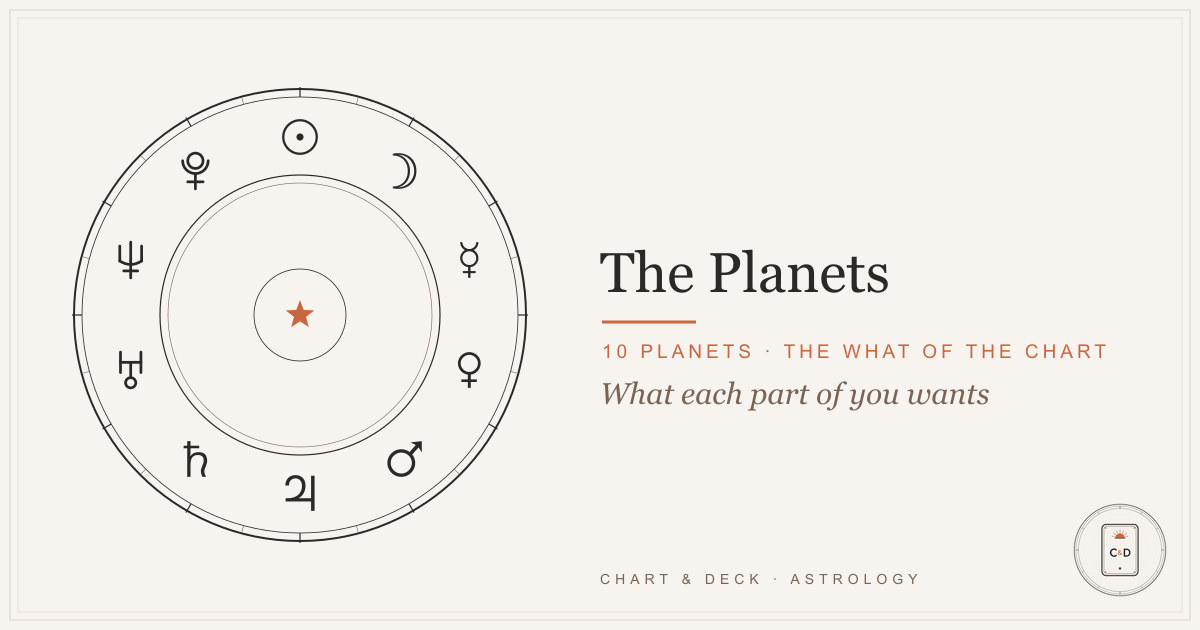
The planets in astrology are the ten moving parts of your birth chart: the Sun, Moon, Mercury, Venus, Mars, Jupiter, Saturn, Uranus, Neptune, and Pluto. Each one is a drive, a specific thing in you that wants something. The Sun wants to shine, Venus wants to love, Mars wants to act, Saturn wants to build something that lasts.
If the planets are what is happening in you, the signs are the style it happens in and the houses are the part of life where it lands.
That three-part grammar is the whole trick to reading a chart, and it is the piece most quick guides skip. Here is what each planet means, how the three layers fit together, and a link to the full guide for all ten.
On this page
What a planet actually is
A planet in astrology is a core drive. Not a force acting on you from space, but a named part of your own nature: the will to be someone (the Sun), the need to feel safe (the Moon), the urge to speak and understand (Mercury).
The chart uses the real positions of the planets at the moment you were born as a map of those drives, read as a tendency, never a fixed fate. The chart shows the drive; you decide what you do with it.
One note for accuracy, since the good sources are honest about it: the Sun and Moon are not technically planets, they are luminaries, the two great lights. Astrology counts all ten together as “the planets” because each one works the same way in a reading, as a distinct drive with its own job.
Signs, planets, houses: how a chart reads
This is the sentence to keep: planets are what, signs are how, houses are where.
The planet is the drive itself, the thing that wants something. The sign it sits in colors the style, the manner, the flavor of how that drive expresses. The house it lands in tells you the actual area of life where it plays out.
Take Venus, the drive to love and value. In one chart Venus sits in cautious, loyal Taurus (the how), in the 7th house of partnership (the where). In another, the same Venus sits in restless Gemini, in the 2nd house of money and worth. Same drive, two completely different lives. The planet names the theme; the sign and house make it yours.
A planet’s expression is shaped by one more thing: the aspects it makes to other planets, the angles that let two drives talk to each other. That is the fourth layer, and it is where a chart stops reading like a list and starts reading like a person.
The ten planets, one by one
Each planet governs one area of your inner life. Here is the plain version of all ten, with a link to the full guide for each.
- The Sun: identity and will. Your core self, your ego, the will to live and be someone. The center the rest of the chart orbits. Rules Leo.
- The Moon: emotion and instinct. Your inner world, your needs, what makes you feel safe, and how you respond before you think. Rules Cancer.
- Mercury: mind and communication. How you think, learn, speak, and make sense of things. Rules Gemini and Virgo.
- Venus: love and values. What you are drawn to, how you love, what you find beautiful, and what you believe you are worth. Rules Taurus and Libra.
- Mars: drive and desire. How you act, pursue, fight, and want. Your energy, your anger, your courage. Rules Aries, and traditionally Scorpio too (Pluto co-rules Scorpio in modern astrology).
- Jupiter: growth and meaning. Where you expand, take risks, find faith, and look for what it all adds up to. Rules Sagittarius, and traditionally Pisces too (Neptune co-rules Pisces in modern astrology).
- Saturn: structure and time. Limits, discipline, responsibility, and the authority you earn the slow way. Rules Capricorn, and traditionally Aquarius too (Uranus co-rules Aquarius in modern astrology).
- Uranus: change and awakening. Freedom, disruption, the sudden break from the expected. Co-rules Aquarius with Saturn, its classical ruler, in modern astrology.
- Neptune: imagination and dissolution. Dreams, spirituality, compassion, and the pull to merge and let go. Co-rules Pisces with Jupiter, its classical ruler, in modern astrology.
- Pluto: depth and transformation. Power, what is hidden, and the cycles of loss and rebirth that remake you. Co-rules Scorpio with Mars, its classical ruler, in modern astrology.
The planets come in three groups
The ten planets are not equal in reach. They fall into three tiers, sorted by how fast they move, and the grouping tells you how personally to read each one.
Personal planets: the Sun, Moon, Mercury, Venus, and Mars. These move quickly and stay close. They describe your individual character, the parts of you that feel most like “you,” and the texture of daily life. When people talk about their chart, they are usually talking about these five.
Social planets: Jupiter and Saturn. Slower, and more about how you meet the wider world. Jupiter is where you grow and reach; Saturn is where you are tested and made to earn. They bridge the personal and the collective.
Outer, or generational, planets: Uranus, Neptune, and Pluto. The slowest of all. They stay in a sign for years, so a whole generation shares the same placement. That is why they read less as personal quirks and more as the deep currents of an era. In your own chart you feel them most sharply through the house they fall in and the aspects they make to your personal planets.
Most quick guides list the planets and stop. This grouping is the part that tells you how loud each planet is in your own life, and it is worth carrying into every placement you read.
How the planets fit together
The planets are one of four layers in a birth chart. The planets are what is happening, the signs are the style, the houses are where it lands, and the aspects are how the planets talk to each other.
Read one planet at a time and you get a trait. Read how they combine, by sign, by house, and by aspect, and you get a life. The full method is in how to read your birth chart.
Questions people ask about the planets
What are the planets in astrology? The ten core drives your birth chart maps: the Sun (identity), Moon (emotion), Mercury (mind), Venus (love and values), Mars (drive), Jupiter (growth), Saturn (structure), Uranus (change), Neptune (imagination), and Pluto (transformation). Each is a distinct part of your nature.
How many planets are there in astrology? Ten. That includes the Sun and Moon, which are technically luminaries rather than planets, but astrology reads all ten the same way, as drives.
What is the difference between planets, signs, and houses? Planets are what (the drive), signs are how (the style it expresses in), and houses are where (the area of life it plays out in). You need all three to read a placement.
What are personal, social, and outer planets? Personal planets (Sun through Mars) shape your individual character; social planets (Jupiter, Saturn) shape how you meet the world; outer planets (Uranus, Neptune, Pluto) move so slowly that a whole generation shares them, so you read them mostly by house and aspect.
Which planet is the most important in a chart? No single one. The Sun, Moon, and rising sign are the usual starting point, the “big three,” but a chart only makes sense when you read the ten together rather than ranking them.
What does it mean when a planet rules a sign? Rulership means a planet has a natural affinity with a sign and is considered strongest there, such as the Sun ruling Leo or the Moon ruling Cancer.
What are the luminaries in astrology? The Sun and Moon are called the luminaries or lights rather than true planets, and they carry the most weight in a chart.
When you want your own chart read
A guide gives you the map. It cannot tell you what it means that your particular planets fall where they do, or which drive is quietly running your year.
When the question shifts from “what do the planets mean” to “what is my own chart actually made of,” a reading does what a guide cannot: a person reads all ten together against your real life, not a lookup table. Start with your free Essence to see your own planets laid out in plain language, or see the readings when you want that fuller read.
For the whole method, go back to how to read your birth chart.