
The Square in Astrology
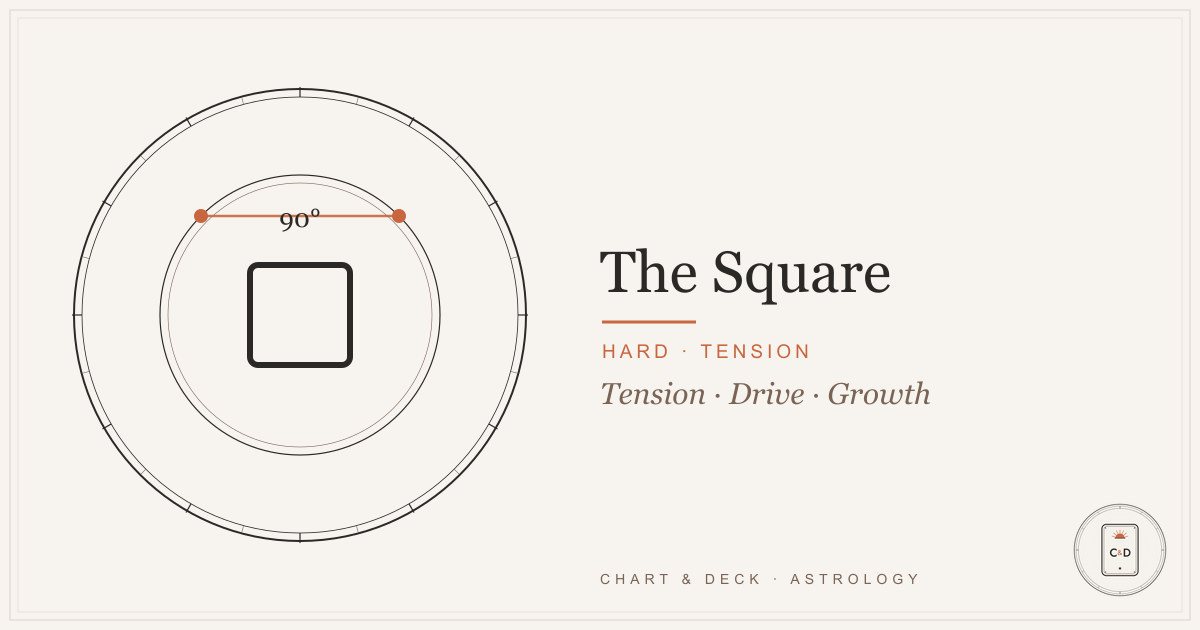
A square in astrology is a 90-degree angle between two planets, one of the two “hard” aspects, and it marks a place where two parts of you pull in different directions. It reads as tension, friction, and turning points. Read closely, a square is less a problem in your chart and more the engine that makes you do something about it.
She took the steady job three years ago because it was the responsible choice, and she has kept a second notebook in the same drawer ever since. Most nights the drawer stays shut. Tonight she takes it out anyway, opens to the next blank page, and starts sketching the thing she has never shown anyone at the firm. The pay stub is still on the counter where she left it, face up.
On this page
What a square is
A square is what happens when two planets sit about 90 degrees apart in your chart. In astrology that angle reads as friction: the two drives involved want different things and keep getting in each other’s way.
It is called a hard, or dynamic, aspect, along with the opposition. “Hard” is an old label and a slightly unfair one. It does not mean bad or unlucky. It means the two planets involved do not blend comfortably, so the pairing tends to generate pressure rather than ease.
That pressure is the whole point of a square. It is the part of the chart most likely to push you off the couch.
Why a square is not the bad news it sounds like
For a long time the square got read as a curse: a source of blockage and struggle to be endured. A lot of horoscope writing still treats it that way. The psychological tradition this brand reads from tells a different story.
Richard Tarnas, drawing the line from Carl Jung through modern astrology, argues that it is often the hard aspects, not the easy ones, that “prove to be the most fruitful in a person’s life,” because the friction creates the pressure to grow. Liz Greene reads the same tension as the thing that drives development rather than blocks it. In this frame a square is not damage. It is a standing invitation to build something out of the conflict.
None of this is a promise. It is a tendency, and a choice. A square shows you where the tension lives. Whether it becomes a lifelong complaint or the reason you finally made the thing is the part that stays yours.
The orb of a square
Two planets are rarely exactly 90 degrees apart. The orb is the room you allow around that angle and still count it as a square. A square that is a degree or two off exact is tight and loud. One that is six or seven degrees off is looser and quieter.
There is no single agreed orb. As a rough guide a square is often read within about six to eight degrees, and the Sun and Moon are sometimes given a little more room, but astrologers genuinely differ here, so treat any number as one practitioner’s convention rather than a rule. The closer to exact, the stronger the square. A square still tightening toward exact tends to feel more active than one already pulling apart.
How a square tends to show up
A square usually feels less like a single event and more like a recurring push and pull between two sides of yourself. The planets involved name the two sides.
Say the drive to feel secure squares the drive to take risks. That can look like a person who builds a safe life and then keeps sabotaging its comfort, or one who leaps and then scrambles for solid ground, over and over, until they learn to hold both. The square does not predict which way it goes. It marks the friction and tends to bring it to a head at turning points, the moments a decision can no longer be deferred.
Read as a blueprint rather than a script, a square is a map of where your growth is likely to cost you something, and where it is likely to matter most.
Common questions about squares
What does a square mean in astrology? A square is a 90-degree angle between two planets. It creates tension between the two drives involved, which tends to show up as friction, inner conflict, and turning points. It is one of the two hard aspects.
Is a square a bad aspect? No. It is challenging, not bad. Squares create pressure, and in the psychological tradition that pressure is treated as the engine of growth rather than a misfortune. The tension is not there to punish you; it is there to make you build.
What is the orb for a square? Commonly around six to eight degrees, though astrologers vary and the Sun and Moon are often allowed a little more. The tighter the orb, the stronger the square.
What does it mean when two planets are square? The two drives those planets represent are pulling against each other. For example, one planet’s need for freedom rubbing against another’s need for security. It reads as usable tension, not a fixed outcome.
What is the difference between a square and an opposition? Both are hard aspects. A square (90 degrees) feels like internal friction between two different drives. An opposition (180 degrees) feels more like two drives facing off, often experienced through other people and the need for balance.
What is a T-square in astrology? A T-square forms when two planets in opposition are both squared by a third. That third planet, the apex, catches the tension of both and becomes the chart’s main pressure point, and often its engine.
Which signs are square each other? Signs three apart that share a quality (cardinal, fixed, or mutable) but differ in element, such as Aries and Cancer, or Taurus and Leo.
When the question outgrows the aspect
A guide tells you what a square is. It cannot tell you which two forces in your own chart are locked in one, or what the tension is actually asking you to do.
When the question moves from “what does a square mean” to “I am stuck between two things and I cannot tell which way to move,” that is where a reading earns its place. A person reads the whole pattern against the decision you are actually sitting with, not a lookup table. Start with your free Essence to see your own chart in plain language, or see the readings when you want to sit with the choice itself.
For how the aspects fit together, go back to the full aspects in astrology guide.