
The Conjunction in Astrology
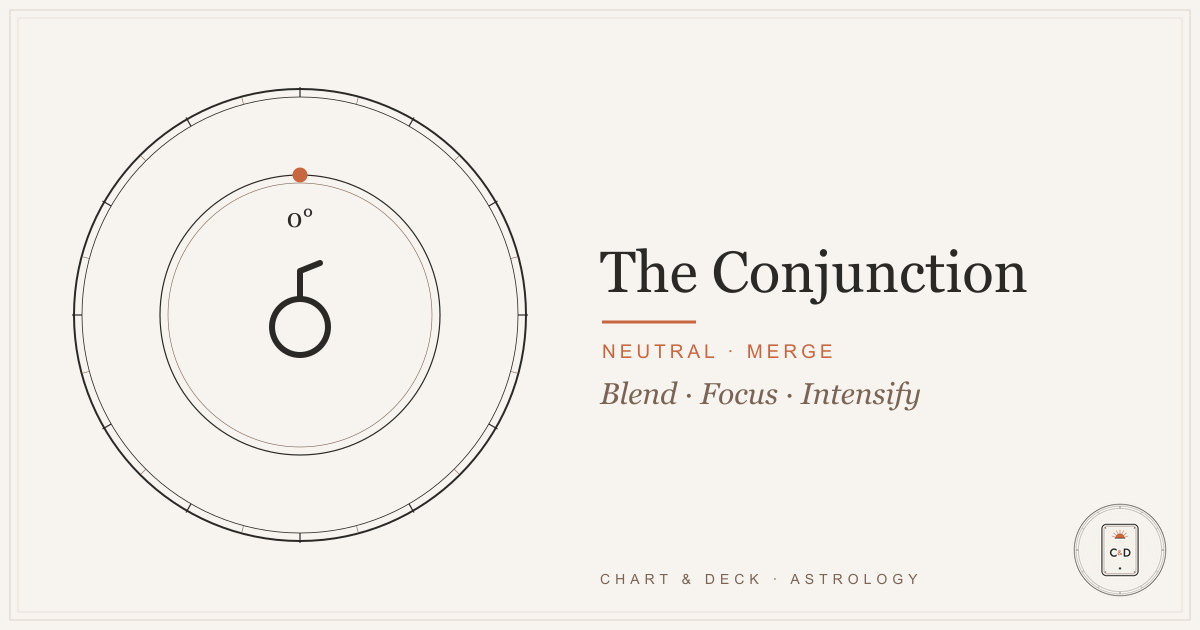
A conjunction in astrology is a 0-degree angle, two planets sitting in the same place in your chart, close enough that their drives stop acting like two separate things and start acting like one. It is one of the two most potent aspects in the chart, and unlike most of the others, it does not come labeled easy or hard.
What it feels like
Ivo cannot remember a version of himself where the ambition and the identity were two different things. Ask him what he wants and he will tell you what he is building. Ask who he is and he will tell you what he is building. His father used to say slow down, you are not the company, and Ivo would nod like a man agreeing to a fact about someone else. Lately the company is between funding rounds, going nowhere for the first time in six years, and he has started missing calls he used to answer on the first ring. He sits in his car outside the office some mornings, engine off, not yet a person and not yet the founder, just watching the lights come on inside one by one.
On this page
What a conjunction is
A conjunction happens when two planets land at or near the same degree of the zodiac, roughly 0 degrees apart. Nothing separates them. In astrology that closeness reads as fusion: the two drives stop taking turns and start running as a single combined force.
It sits alongside the opposition as one of the two strongest aspects a chart can produce. Where a square creates friction between two things that resist each other, a conjunction removes the distance between them entirely. Whatever those two planets represent, you likely experience it as one trait rather than two forces taking turns, which is what makes a conjunction so noticeable in a chart, and so hard to describe in a single word.
Why a conjunction is neither good news nor bad news
Most other aspects sort cleanly into a family. The square and opposition are called hard. The trine and sextile are called soft. The conjunction sits outside that split, neutral, and its value depends entirely on which two planets are involved.
Two planets that already work well together, fused into one theme, tend to read as unusually easy: a natural confidence that never had to be learned the hard way. Two planets that pull in more difficult directions, fused the same way, tend to read as intense or even overwhelming, a single trait carrying more charge than a person can always metabolize in the moment.
Neither outcome is fixed by the conjunction itself. It just turns up the volume on whatever is there. Liz Greene and Richard Tarnas, writing in the psychological tradition this brand draws from, treat that intensity as raw material, neither gift nor curse until a person has lived with it long enough to know which.
The Full Natal Reading · $19 · which contacts you actually have
Worth knowing: you may not have a single conjunction that matters.
An aspect is a relationship between two planets, and this page describes what that relationship does in general. What it cannot tell you is whether your chart holds one, between which two functions, or how tight it runs. The Full Natal Reading picks the handful of contacts that actually carry your story, the closest ones, and writes each as two parts of you meeting: fused, at odds, or in easy flow, landed in a moment you will recognise rather than a definition. Most charts are full of angles and run on only a few of them. In your inbox in minutes.
See which contacts run your chart — $19 →Birth time optional. With it, the contacts to your rising sign and Midheaven come in too.
Your $19 comes off a full personal reading later, if you go further.
The orb of a conjunction
Two planets are almost never at the exact same degree. The orb is how much room astrologers allow around that exact point before the conjunction stops counting as one.
Conjunctions get the widest orb of any aspect, commonly cited somewhere around 7 to 10 degrees. That number moves depending on which astrologer or software you ask, so treat any figure you see as typical, not a rule carved anywhere. The Sun and Moon are often given a little extra room, though that is a tendency rather than a law. What holds steady across sources is the direction of the effect: the tighter the orb, the stronger the fusion. A conjunction just a degree apart tends to feel inseparable. One near the outer edge still counts, but reads as two things brushing against each other rather than fully becoming one.
How a conjunction tends to show up
A conjunction usually does not feel like an aspect at all. It feels like a personality trait, because the two planets involved have stopped registering as two things to the person living with them.
Say the drive behind how someone loves and the drive behind how someone asserts themselves land in the same place. That can show up as a person who cannot separate wanting something from going after it hard, for better and for worse. A conjunction tends to concentrate rather than divide, which is why people who have one often describe it less as a trait they have and more as a trait they are.
None of that is fixed, which is the whole brand line about a chart: a blueprint, not a script. The conjunction fused two forces into one before you had any say in it. The ongoing work, running that combined force on purpose instead of by accident, stays yours.
Common questions about conjunctions
What does a conjunction mean in astrology? A conjunction is a 0-degree angle between two planets. They fuse into a single combined theme rather than acting as separate drives, and it is one of the two most potent aspects in a chart.
Is a conjunction a good aspect? Neither good nor bad by itself. A conjunction is neutral. Whether it feels easy or intense depends entirely on which two planets are involved and how well they naturally combine.
What is the orb for a conjunction? Commonly around 7 to 10 degrees, the widest orb among the major aspects, though astrologers vary and the Sun and Moon are sometimes allowed extra room. The tighter the orb, the stronger the fusion.
What does it mean when two planets are conjunct? The two drives those planets represent are no longer separable in how they show up. They act as one combined force, amplifying each other, rather than taking turns.
How is a conjunction different from other aspects? Most aspects describe a relationship between two distinct drives, easy or tense. A conjunction removes the distance between them. There is no push or pull left to describe, because the two planets are, functionally, acting as one.
What is a stellium in astrology? A stellium is three or more planets conjunct in the same sign or house. It concentrates a lot of energy in one area of the chart, turning up the volume there even more than a single conjunction.
What does a conjunction mean in synastry? Between two people’s charts a conjunction is a strong point of fusion or attraction. Its tone depends on which two planets meet: easy when they get along, intense when they do not.
When the question outgrows the aspect
A page like this can define a conjunction. It cannot tell you which two parts of your own identity are fused this tightly, or which one of them is quietly running the other.
When the question moves from “what does a conjunction mean” to “I cannot tell where my ambition ends and I begin,” a definition stops being enough. A person can read the specific fusion in your chart against the life you are actually living and tell the two planets apart when you no longer can. Start with your free natal chart reading to see your own chart in plain language, or see the readings when you want to sit with what that fusion is actually asking of you.
For how the aspects fit together, go back to the full aspects in astrology guide.
The Full Natal Reading · $19 · which contacts you actually have
This page explains the conjunction. Whether you have one worth reading is another question.
An aspect is a relationship between two planets, and this page describes what that relationship does in general. What it cannot tell you is whether your chart holds one, between which two functions, or how tight it runs. The Full Natal Reading picks the handful of contacts that actually carry your story, the closest ones, and writes each as two parts of you meeting: fused, at odds, or in easy flow, landed in a moment you will recognise rather than a definition. Most charts are full of angles and run on only a few of them. In your inbox in minutes.
See which contacts run your chart — $19 →Birth time optional. With it, the contacts to your rising sign and Midheaven come in too.
Your $19 comes off a full personal reading later, if you go further.