
The Sextile in Astrology
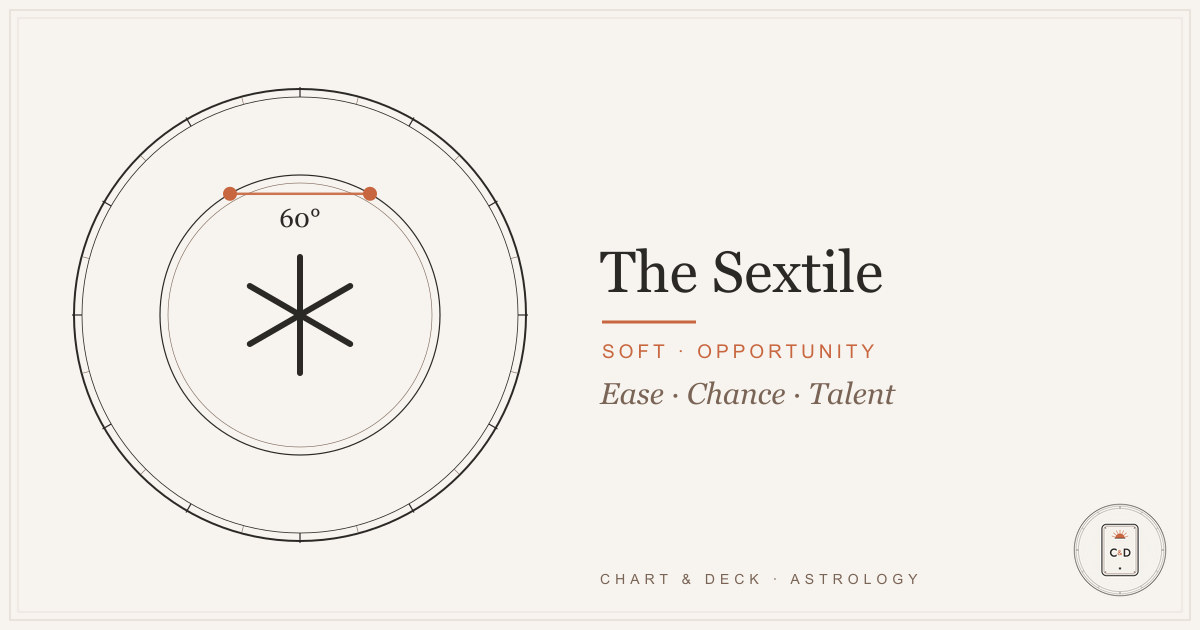
A sextile in astrology is a 60-degree angle between two planets, one of the soft aspects, and it marks a place in your chart where two drives cooperate easily, if you actually use them. Nobody hands you a finished gift here. Somebody just left a door unlocked, and it’s still on you to try the handle.
Amara had been sketching cabinetry on the backs of invoices since she was nineteen, the kind of drawings people admire for a second and then hand back. She kept doing the books for her cousin’s shop instead, because the books paid on time and the bench saw did not need her opinion. One slow Tuesday a client canceled a custom order and left the cut boards behind, unclaimed, stacked against the wall by the table saw. Amara clocked out at six, clocked herself back in at seven, and started squaring the offcuts into something nobody had ordered. Three weeks later the shop’s front window held a shelf with her own dovetails in it, price tag still swinging.
On this page
What a sextile is
A sextile is the 60-degree angle, two-twelfths of the way around the wheel. The two drives involved get along without much friction, and what one wants tends to help the other along instead of blocking it.
It belongs to the soft, or easy, family, alongside the trine. But among the soft aspects it is the quieter cousin. A trine tends to run on its own; a sextile tends to sit there, available, until something makes you reach for it. Of the five major aspects, planets involved included, a sextile carries the least force, which is exactly why so many people never notice they have one.
Nobody points a sextile out to you. You have to go looking.
The open door you still have to walk through
Soft aspects get sold as free gifts, and the sextile takes the brunt of that oversimplification. Call it a talent lying around, easy money, a lucky break built into the chart. None of that holds up.
A sextile is closer to a door propped open a few inches, on a hallway you don’t walk down every day. The two drives involved are willing to work together. They are not going to drag you toward each other. Nobody trips and falls into a finished skill.
This is the detail that separates the sextile from its louder cousin the trine. A trine tends to express itself whether you notice it or not, sometimes so smoothly the person barely registers it as a strength. A sextile needs a decision. It is potential that sits quietly until you pick it up, practice it, or simply choose the smaller, harder option of walking through the door instead of past it.
Nobody can tell you the door leads somewhere good. Only that it opens easier than most. What you do with an easy door is still a choice, and choices are the one thing a chart never makes for you.
The orb of a sextile
Two planets rarely land at a clean 60 degrees. The orb is the margin either side of that angle that a sextile is still allowed to occupy. Among the five aspects, this is typically the narrowest window of all, which fits: a small angle asks for a small margin.
Astrologers argue about the number more than you’d expect for something this small. A rough guide puts a sextile within about four to six degrees, tighter than what a square or an opposition usually gets, and the Sun or Moon sometimes buys a little extra room. Pick any astrologer and you’ll get a slightly different figure, so hold the number loosely. What does hold: closer to exact tends to read as more urgent, a door worth trying today rather than someday.
How a sextile tends to show up
Most people carry a sextile for years without noticing, a low hum of possibility easy to walk past. The planets involved name what’s on offer.
Say the drive to communicate sextiles the drive to build things that last. That can look like someone who could write, or teach, or sell an idea, and simply never gets around to it, not from lack of ability but from lack of a reason to start. Then something small nudges it. A deadline. A person who asks the right question. A pile of cut boards nobody comes back for. The sextile does not manufacture that nudge. It just makes the response easier than it would otherwise be, once the nudge arrives.
Call it a blueprint, not a script: it marks where your effort is likely to meet the least resistance, never where effort stops being required.
Common questions about sextiles
What does a sextile mean in astrology? A sextile is a 60-degree angle between two planets. It creates an easy, cooperative link between the two drives involved, read as opportunity or latent talent that still needs to be acted on. It belongs to the soft, or easy, aspect family.
Is a sextile a good aspect? Generally, yes, in the sense that it tends to feel supportive rather than tense. But a sextile is passive compared to a trine. It offers an opening rather than delivering a result, so “good” here means available, not automatic.
What is the orb for a sextile? Commonly around four to six degrees, the narrowest typical range of the five major aspects, though astrologers vary and some allow the Sun and Moon extra room. The tighter the orb, the stronger the sextile.
Do I have to do anything for a sextile to work? In practice, yes. A sextile is the aspect most often described as needing conscious effort to activate. The ease is real, but it shows up as reduced resistance, not as an outcome that arrives on its own.
What is the difference between a sextile and a trine? Both are soft aspects. A trine (120 degrees) tends to flow on its own, sometimes so easily the person barely notices the strength. A sextile (60 degrees) offers the same kind of cooperation between two drives, but usually only once you choose to act on it.
Which signs are sextile each other? Signs two apart that share a compatible polarity, pairing fire with air and water with earth, for example Aries and Gemini, or Taurus and Cancer.
What does a sextile mean in synastry? Between two charts it shows easy cooperation and encouragement, the kind of connection that supports good communication and shared opportunities without much friction.
Finding your own unlocked door
This page can tell you what a sextile is in general. It has no idea which door in your own chart is propped open, or what’s sitting behind it.
That takes a look at your actual placements, not a definition. Start with your free Essence to see your own chart in plain language and find where your ease actually lives, or see the readings if you already know the door and want help deciding whether to walk through it.
For how the aspects fit together, go back to the full aspects in astrology guide.