
How to Read Your Birth Chart
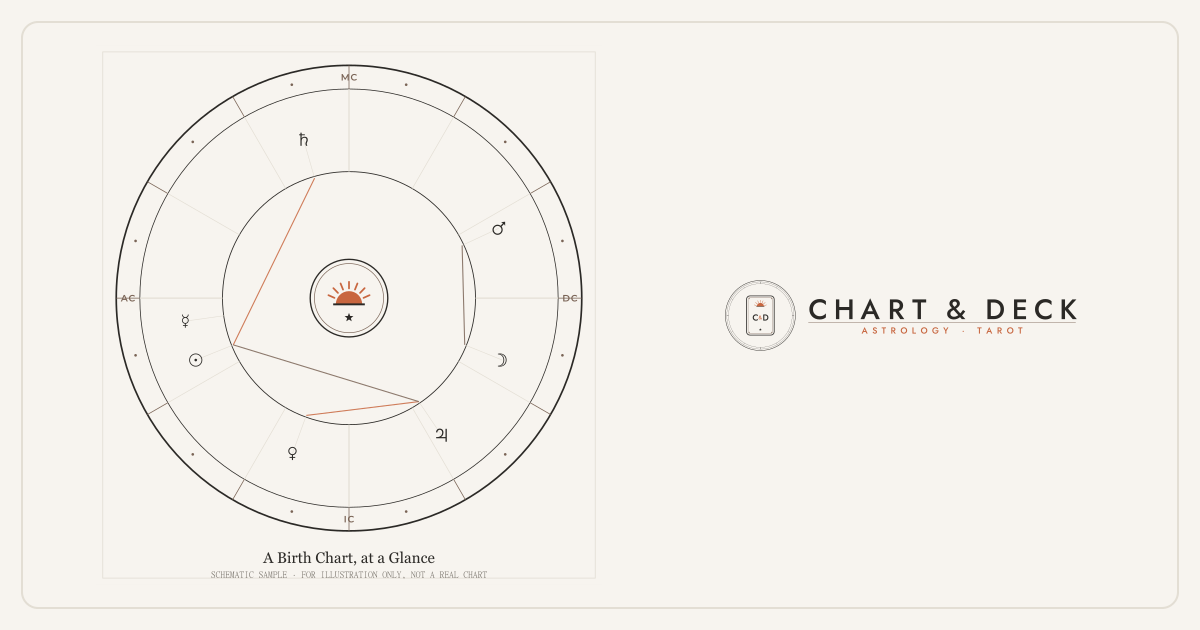
Your birth chart is not a personality quiz. It is a map drawn at the exact moment you arrived, showing the shape of the patterns your life keeps returning to. To read it, you work through four layers: your big three, the planets, the houses, and the aspects. Each one adds detail to a single picture of how you are built and what you tend to meet.
A chart shows tendencies, not outcomes. Blueprint, not script.
On this page
Step 1: Get your actual birth chart
You need three pieces of information to draw your chart: your birth date, your birth time, and your birthplace. The time matters more than most people expect. It sets your Rising sign and anchors all twelve houses. Without it you can still read your planets and signs; you simply leave the houses out rather than guess.
Your free natal chart reading draws the chart from your birth details and reads the core of it back to you in plain language, so you are not staring at a wheel of symbols with no entry point.
The Full Natal Reading · $19 · in minutes
Worth knowing: your your birth chart never acts alone.
Your your birth chart sits inside a whole chart, pulling on everything else in it. The Full Natal Reading reads all of it together — the core self, the planets, the arenas your energy pools in, the wiring underneath — in plain language, as one written portrait of you. Then you pick a card by hand, and it’s read against your chart. In your inbox in minutes.
 Read your whole chart — $19 →
Your $19 comes off a full personal reading later, if you go further.
Step 2: Start with your big three
Your Sun, Moon, and Rising sign together account for most of what makes you recognizably you, and they each describe a different layer of that.
Your Sun is the center: what you are growing into, what you are here to build. Your Moon is the interior: what you feel, what you need to feel safe, the part of you that runs even when no one is watching. Your Rising sign, also called the Ascendant, is the threshold: how you enter a room and how the room reads you.
Read each one in lived terms, not label terms. Sun in Leo is less “you are dramatic” and more “you need to matter, and you know how to make the people around you feel like they do.” The sign is a quality, not a sentence.
Step 3: Place each planet by sign
Every planet in your chart governs one mode of operating, and the sign it sits in is the color it carries. The same drive, in a different sign, behaves differently.
The inner planets move fast and describe the personal: Mercury is how you think and speak; Venus is how you love and what you find valuable; Mars is how you want things and how you go after them. Jupiter and Saturn describe how you grow and where you meet resistance. Uranus, Neptune, and Pluto move slowly, coloring a whole generation, and their meaning sharpens wherever they fall in your personal chart.
The full plain-language breakdown lives in the planets in astrology. Start there if a specific planet is pulling your attention.
Step 4: See which house each planet falls in
The twelve houses are the arenas of life. The first house is your body and self-presentation. The fourth is home and what formed you. The seventh is one-on-one partnership. The tenth is career and the mark you make publicly. Each of the twelve covers a different slice of lived experience.
A planet’s sign tells you how it acts. Its house tells you where. Saturn in the tenth house of career is a different story from Saturn in the fourth house of family and roots, even though Saturn itself behaves the same way in both. The context changes everything. The 12 houses in astrology walks through each one.
Step 5: Read the aspects between planets
Aspects are the angles formed between planets, and they tell you which parts of you are in conversation and which are in tension. This is where the chart stops being a list and starts being a story.
A trine is fluency: two planets that hand things to each other easily. A square is productive friction, the kind that does not let you rest until something is resolved. A conjunction fuses two energies so completely they operate as one. The tighter the aspect, within a few degrees, the louder it speaks. Aspects in astrology covers the main ones.
Putting it together: one picture, not a checklist
This is the part most tutorials skip. You are not reading twelve separate facts about yourself. You are reading one picture made of twelve parts.
A Sun that wants recognition, a Moon that needs privacy, a Saturn squaring both of them: that tension is not a flaw in the chart. It is the chart telling you something real about the central friction you work with. The most useful charts are often the most complicated, because they name the thing you already know is there.
Every line of it is a tendency, not a verdict. The chart describes the weather you came in with. You still decide what you build in it.
Common questions
Do I need my birth time to read my chart? You need it for your Rising sign and your houses. Without it you can still read your Sun, Moon, and every other planet by sign, which covers most of the picture. Leave the houses out rather than guess.
Can you read a birth chart for free? Yes. Your free natal chart reading draws your chart and reads the core of it at no cost.
Is astrology real? It is not prediction. Read as psychology and pattern, a chart is a mirror you hold up to your own life and check against it. More on how we think about that: how it works.
Start with your own chart
The fastest way to understand a birth chart is to see yours clearly. Your free natal chart reading does that in a few minutes.
And when a specific question stops being background noise and starts sitting on your chest, a full reading takes your chart, your cards, and the psychology and works it all the way down. See the readings.
The Full Natal Reading · $19 · in minutes
This is the general read of your birth chart. Yours doesn’t stand alone.
Your your birth chart sits inside a whole chart, pulling on everything else in it. The Full Natal Reading reads all of it together — the core self, the planets, the arenas your energy pools in, the wiring underneath — in plain language, as one written portrait of you. Then you pick a card by hand, and it’s read against your chart. In your inbox in minutes.
Read your whole chart — $19 →Your $19 comes off a full personal reading later, if you go further.