
The Opposition in Astrology
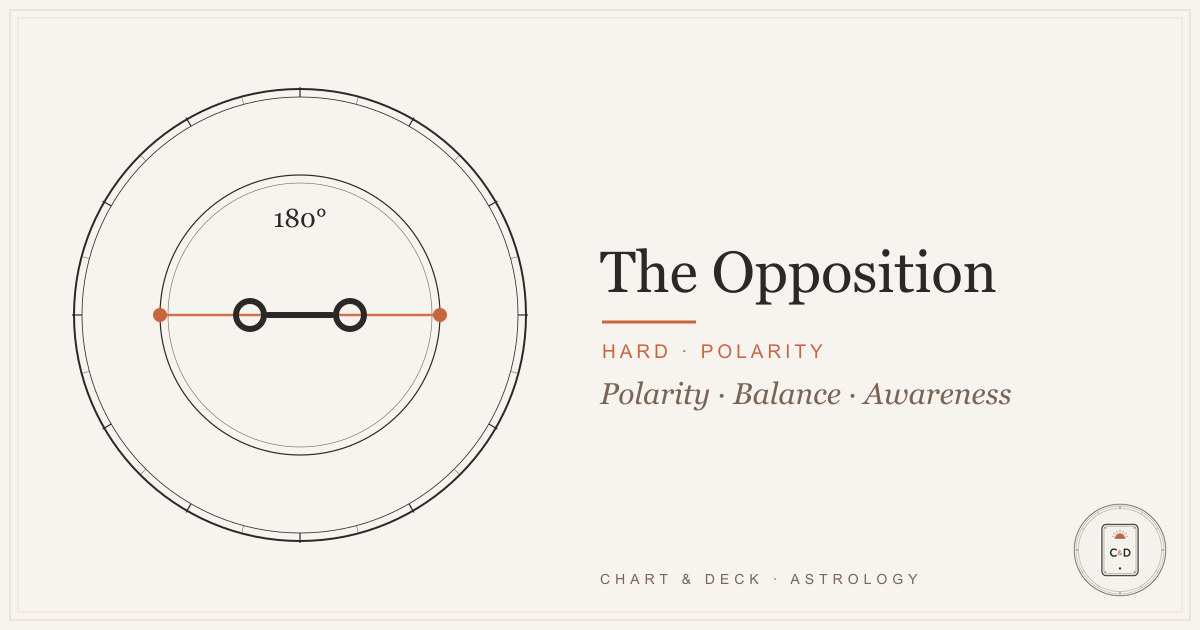
An opposition in astrology is a 180-degree angle between two planets, the two ends of the same axis staring straight at each other. It is one of the two “hard” aspects, and one of the two most potent aspects in the whole chart. Rather than blending, an opposition works through contrast: two drives that need each other to make sense, and a pull toward whichever one you have not yet learned to hold.
What it feels like
Jonah has dated three people in four years who all, eventually, accused him of the same thing: that he vanished the moment things got steady. He said as much to his sister on the phone last week, half joking, waiting for her to disagree. She didn’t. Instead she asked when he’d last canceled plans on a whim, just for himself, with no one else’s steadiness to react against. He didn’t have an answer. He’s still turning the question over now, phone long since hung up, the apartment quiet the way it always is, one lamp on, the second coffee mug still in the cabinet where it’s been since March.
On this page
What an opposition is
An opposition happens when two planets sit roughly 180 degrees apart, on opposite sides of the chart from each other. Picture a seesaw with a planet weighting each end. Neither side gets to just win. The whole structure depends on both.
It belongs to the hard, or dynamic, family, alongside the square. Hard does not mean unlucky. It means the two planets involved do not sit easily together, so instead of merging they stay in a kind of ongoing negotiation. Along with the conjunction, an opposition is one of the two most potent aspects a chart can carry. When it shows up, it tends to matter.
What sets an opposition apart from a square is not the intensity. It is the shape. A square is friction folded inward, one part of you against another part of you. An opposition is fundamentally relational. The tension does not stay contained in one place. It looks for something, or someone, standing across from you to complete it.
Why you tend to meet it in other people
This is the part that makes an opposition distinct, and the part most worth sitting with. The two planets in an opposition describe two real needs inside you. But it is common to live comfortably on one end of that axis and leave the other largely unclaimed, until it starts showing up on the outside instead.
Richard Tarnas describes this pattern as projecting unowned qualities: the parts of ourselves we have not developed or admitted to do not simply disappear. They tend to appear again, dressed as someone else’s personality, someone else’s demand, someone else’s flaw. Carl Jung put the mechanism plainly: what is forced to remain unconscious comes to us as fate. Not punishment. Just the same material, arriving from a different direction because it never got a hearing from the inside.
Practically, that can look like being endlessly drawn to partners, coworkers, or friends who embody the very quality you have quietly disowned in yourself. The free-spirited person who keeps falling for control freaks. The cautious one who keeps hiring wild cards. An opposition does not force this. It makes the pattern more likely, and more visible once you know to look for it.
The way through, in this reading, is not to defeat the other end of the axis or to declare a winner. It is awareness first, then balance: learning to hold both ends yourself, so the world stops having to hand you the half you left behind.
The Full Natal Reading · $19 · which contacts you actually have
Worth knowing: you may not have a single opposition that matters.
An aspect is a relationship between two planets, and this page describes what that relationship does in general. What it cannot tell you is whether your chart holds one, between which two functions, or how tight it runs. The Full Natal Reading picks the handful of contacts that actually carry your story, the closest ones, and writes each as two parts of you meeting: fused, at odds, or in easy flow, landed in a moment you will recognise rather than a definition. Most charts are full of angles and run on only a few of them. In your inbox in minutes.
See which contacts run your chart — $19 →Birth time optional. With it, the contacts to your rising sign and Midheaven come in too.
Your $19 comes off a full personal reading later, if you go further.
The orb of an opposition
Two planets are almost never exactly 180 degrees apart. The orb is how much drift from that exact angle still counts as an opposition. A tight orb, a degree or so off exact, reads as sharp and immediate. A wide one reads as a slower, more background hum.
There is no fixed number every astrologer uses. As a general range, an opposition is often counted within about five to ten degrees, with the Sun and Moon sometimes given extra room, though this varies by astrologer and by school, so treat any figure as a working convention rather than a rule. What holds across all of them: the tighter the orb, the stronger the pull.
How an opposition tends to show up
An opposition rarely announces itself as a single dramatic event. More often it plays out as a recurring dynamic, the same shape returning in different rooms with different faces.
Say the drive for independence sits opposite the drive for partnership. That can surface as someone who keeps choosing people who need a great deal from them, then feels boxed in by exactly the closeness they sought out. Or it shows up as the reverse: a string of relationships that stayed too loose to hold anything, because commitment felt like losing yourself. The opposition does not decide which pattern plays out. It marks where the axis runs, and tends to bring both ends into the room at once, usually through whoever is standing closest.
Think of it as a blueprint, not a script. An opposition shows where your growth tends to depend on somebody else showing up first, at least until you learn to supply the other half yourself.
Common questions about oppositions
What does an opposition mean in astrology? An opposition is a 180-degree angle between two planets. It creates polarity between the two drives involved, often experienced through other people, and it asks for awareness and balance rather than a winner.
Is an opposition a bad aspect? No. It is intense, not bad. Along with the conjunction, it is one of the two most potent aspects in a chart, and psychological astrology treats that intensity as the material for real growth, not a curse.
What is the orb for an opposition? Commonly around five to ten degrees, though astrologers vary and the Sun and Moon are sometimes given more room. The tighter the orb, the stronger the opposition.
Why do I keep attracting the same type of person? In this reading, it can be a sign of an opposition at work. A quality you have not developed in yourself tends to show up projected onto other people instead, drawing you toward partners or situations that carry the half of the pattern you have left unclaimed.
What is the difference between an opposition and a square? Both are hard aspects. A square (90 degrees) plays out mostly as internal friction between two drives inside one person. An opposition (180 degrees) plays out between two poles facing each other, more often lived out through other people and the work of balancing both sides.
Which signs are opposite each other? Signs six apart, across the wheel: Aries and Libra, Taurus and Scorpio, Gemini and Sagittarius, and so on. Each pair is a natural polarity.
What does an opposition mean in synastry? Between two charts each person tends to carry one end of a polarity. It pulls strongly, and works best when both people integrate the two sides rather than split them.
When the question outgrows the aspect
A guide can tell you what an opposition is in general. It cannot tell you which two ends of your own chart keep facing off, or whose face keeps showing up on the other side of that axis.
When the question moves from “what does an opposition mean” to “why do I keep living out one half of this with someone else,” that is where a reading does more than a definition can. A person reads the actual pattern in your chart, not a generic list. Start with your free natal chart reading to see your own chart in plain language, or see the readings when the question is really about a bond you are standing inside right now.
For how the aspects fit together, go back to the full aspects in astrology guide.
The Full Natal Reading · $19 · which contacts you actually have
This page explains the opposition. Whether you have one worth reading is another question.
An aspect is a relationship between two planets, and this page describes what that relationship does in general. What it cannot tell you is whether your chart holds one, between which two functions, or how tight it runs. The Full Natal Reading picks the handful of contacts that actually carry your story, the closest ones, and writes each as two parts of you meeting: fused, at odds, or in easy flow, landed in a moment you will recognise rather than a definition. Most charts are full of angles and run on only a few of them. In your inbox in minutes.
See which contacts run your chart — $19 →Birth time optional. With it, the contacts to your rising sign and Midheaven come in too.
Your $19 comes off a full personal reading later, if you go further.