
What Is the I Ching? The Oracle Jung Took Seriously
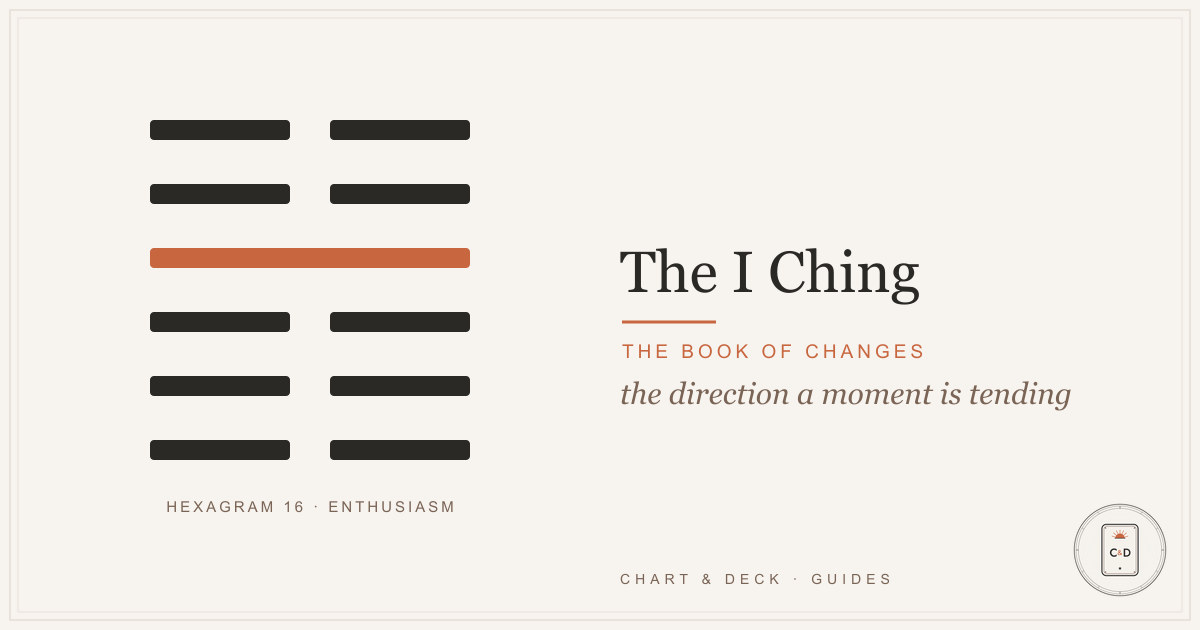
The I Ching, or Book of Changes, is a Chinese oracle roughly three thousand years old: sixty-four six-line figures called hexagrams, each describing a shape that change takes. You consult it by casting coins or yarrow stalks to build one hexagram, and the book answers with counsel about the situation you are standing in.
Not a verdict. Counsel.
That difference is the I Ching’s real meaning, and it is why the most serious psychologist of the twentieth century wrote the foreword to its most famous translation.
On this page
This is what it feels like
The change is usually already moving
A woman rides the same train home she has taken for nine years. Tonight there is a leaving card in her bag, signed for a colleague who is off to do the thing everyone at the office quietly wishes they were doing. She signed it so happy for you! with the exclamation mark and everything.
The train stops between stations, the way it always does at the junction. She knows this darkness by heart. Nine years of this exact pause, the carriage lights flickering once, the man across the aisle asleep before the river.
She takes out her phone and opens the property listings for a town she has never mentioned to anyone. Not tonight; she has been opening them for months, the way you press a bruise.
Two bedrooms, a workshop out back. She knows the commute from that town does not exist, which is the point.
The train shudders and moves. She closes the app. But as the lights of the junction slide past, she does something small: she saves the listing.
First time. The carriage rocks on toward her stop, and she stays in her seat, and everything is exactly as it was, except that it is not.
That kind of moment, quietly already moving, is exactly what the I Ching was built to read.
What the book actually is
The oldest layer of the I Ching is a divination text from China’s Western Zhou period, roughly the 9th century BC, making it one of the oldest books in continuous use anywhere. Over centuries it accumulated commentary and became a foundation text for both Confucian and Taoist thought: less a fortune-telling manual than a study of how situations ripen, stall, turn, and resolve.
Its alphabet is simple. A line is either solid (yang) or broken (yin). Stack three and you get one of eight trigrams; stack two trigrams and you get one of the sixty-four hexagrams.
Each hexagram has a name and a judgment, which is the counsel itself. It also carries an image, the picture behind the name: Difficulty at the Beginning, Waiting, The Well, Pushing Upward, Breakthrough.
The full reference
All 64 hexagrams in King Wen order, each with what it means and how its changing lines read.
Open the 64 hexagram reference →The eight trigrams, since every hexagram is a conversation between two of them:
| Trigram | Name | Image |
|---|---|---|
| ☰ | Qian | Heaven, the creative |
| ☷ | Kun | Earth, the receptive |
| ☳ | Zhen | Thunder, the arousing |
| ☵ | Kan | Water, the abyss |
| ☶ | Gen | Mountain, keeping still |
| ☴ | Xun | Wind and wood, the gentle |
| ☲ | Li | Fire, the clinging |
| ☱ | Dui | Lake, the joyous |
How a cast works, in one paragraph
You hold a real question, throw three coins six times, and each throw gives you one line, built bottom to top, until a hexagram stands there. Some lines arrive marked as changing lines, the live edges of the situation already becoming something else; change each to its opposite and a second hexagram appears, the direction the moment is tending. The full mechanics are in the coin method guide, and all sixty-four answers live in the hexagram reference.
What Jung saw in it
In 1949, Carl Jung wrote the foreword to the Wilhelm/Baynes translation of the I Ching, the edition that carried the book into the Western mainstream and still the one to own. He did not argue the oracle predicts the future.
He argued something stranger and more useful: that the moment you cast in belongs to the same pattern as the question you cast about. He coined a word for meaningful coincidence of that kind, synchronicity, and treated the I Ching as its oldest working instrument.
Read that way, the book is not telling you what will happen. It is handing you a mirror angled at the present, sharp enough to catch what you already half-know, the way the woman on the train already knew.
Jung’s own practice was to take the hexagram as a portrait of the psychological moment and ask what it made conscious. That is precisely the register we read it in.
Richard Wilhelm, the translator, spent decades in China working with a Chinese scholar of the old school; his edition is dense and worth the density. If you buy one book after this page, buy that one.
Is it fortune-telling?
No, and the book itself would agree. The judgments speak in counsel, not decree: this furthers, this does not, persistence brings good fortune, do not act now. The I Ching assumes throughout that you have choices, which is why it bothers advising you.
Anyone who tells you the future is settled is fooling you, or fooling themselves. The oracle’s honest claim is smaller and better: the situation has a shape, the shape has a direction, and knowing both changes what you do next.
Questions people ask
Is the I Ching Taoist or Confucian? Both traditions built on it, and it predates both. Confucian commentary shaped its ethics; Taoism absorbed its picture of change. The book itself is older than the argument.
How old is it? The core text is roughly 3,000 years old, with commentary layers accumulating for centuries after. It is one of the oldest books still in daily use.
Which translation is best? Wilhelm/Baynes, the one with Jung’s foreword. Newer scholarly translations correct details; none replaces it as the reading edition.
Can it predict the future? It describes the direction a situation is tending, which is different from prophecy in exactly the way that matters: the tendency includes you, and you have not decided yet.
Do I need special coins? No. Three matching coins of any kind. The coin method guide shows the whole procedure.
Where it sits in a reading
In a full Chart & Deck reading the I Ching has one seat at the table, and it is the one this page has been describing: the cards map the situation, the runes surface the hidden forces, and the I Ching reads the direction of change, where this is heading and the live edge where it moves. If your question is the on-the-train kind, the sort that is quietly already in motion, that is what the Life Direction reading was built for. Or begin where every reading begins, with your free Essence chart.