
How to Cast the I Ching with Three Coins
Three coins, six throws, one hexagram. The coin method is the simplest honest way to do an I Ching reading yourself, and this page gives you the whole of it, including the step most guides wave past: what to do when a changing line shows up. Ten minutes from here, you can cast properly.
On this page
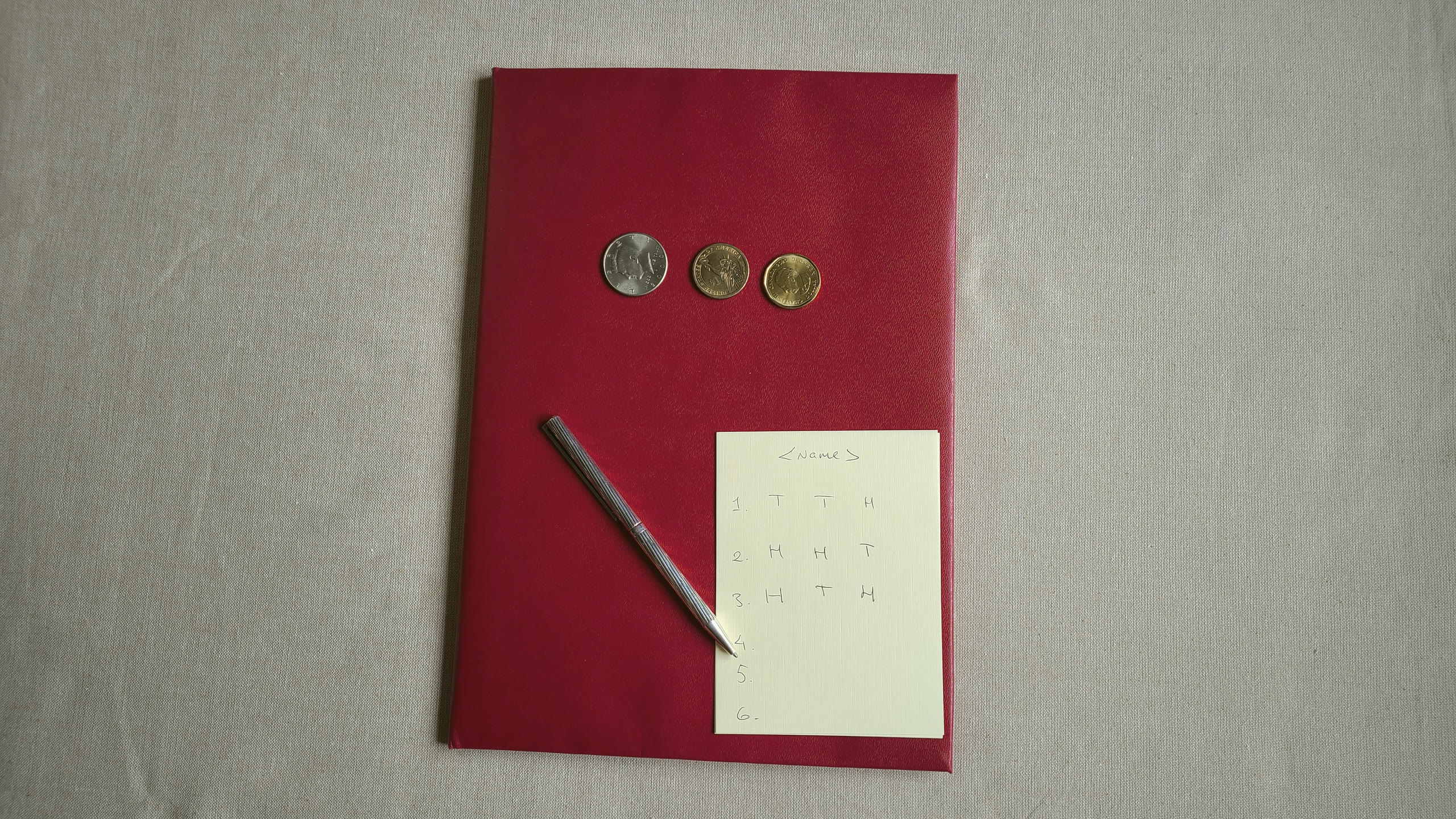
What you need
Three matching coins. Any three.
The traditional bronze coins with square holes are pleasant to handle and completely optional. The oracle does not check your wallet.
Add a pen, paper, and a question you mean.
Word the question first
The I Ching answers best when the question is about a situation and your right relation to it, not a demand for a verdict. “Should I take the offer?” casts the book as judge. “What should I understand about taking this offer?” casts it as counsel, which is the job it is actually good at.
One question per cast. Write it at the top of the page.
The cast, step by step
Six throws build one hexagram, always bottom to top. Here is the exact sequence.
- 6: broken, changing (old yin)
- 7: solid, stable (young yang)
- 8: broken, stable (young yin)
- 9: solid, changing (old yang)
- Throw all three coins at once. This is one throw, and it produces one line.
- Score it. Heads counts 3, tails counts 2. Add the three coins: the only possible totals are 6, 7, 8, or 9.
- Draw the line. Each total maps to one of four line types.
Mark changing lines with a cross or a circle, because everything in the next section depends on them.
- Build bottom to top. The first throw is the bottom line, the sixth throw is the top. This matters; the hexagram is read as a situation growing upward from its root.
- Six throws, six lines, one hexagram. Find its number and name in the 64-hexagram reference, by scanning names and keywords until yours announces itself.
The changing lines: the part everyone skips
If every line came up 7 or 8, you have one stable hexagram. Read its judgment and image, and you are done. Clean answer, clean situation.
But most casts bring at least one 6 or 9, and this is where the oracle earns its name, the Book of Changes. A changing line is a live edge: the exact place in the situation where the ground is already shifting. Here is the reading order, in full.
First, the primary hexagram. The one you cast. It describes the situation as it stands, and you read its judgment and image as the base counsel.
Second, the changing lines themselves. Each hexagram carries a short text for each of its six lines. Read the text only for the lines that came up 6 or 9.
These are the most specific words the oracle will give you: not the situation in general, but the precise point where it is moving, and your right conduct there. If several lines are changing, tradition and common sense agree the topmost changing line usually carries the day.
Third, the transformed hexagram. Flip every changing line to its opposite (a changing solid becomes broken, a changing broken becomes solid), leave the stable lines alone, and look up the new figure. This second hexagram is not a second answer and not a prediction.
It is the direction the situation is tending if the currents named by the changing lines run their course. Primary tells you where you stand; transformed tells you which way the floor is tilting.
That order, primary, then lines, then transformed, is the whole discipline. Read all three as one sentence: here is the situation; here are its live edges; here is where it leans.
A real cast
The example above is not hypothetical for us. It is on film. In a client reading we cast hexagram 16, Enthusiasm, with its entire lower trigram changing, transforming into hexagram 34, Great Power.
Read in order: Enthusiasm named a genuine momentum already alive in the questioner’s situation, something that did not need to be argued into existence. The changing lines sat at the base of the figure, the foundation moving.
And Great Power named the direction: momentum maturing into real strength, with the oracle’s standing caution that strength used well never needs to shove.
Situation, live edge, lean. One cast, one sentence.
Common mistakes
Building top-down. The first throw is the bottom line. If you build downward the hexagram comes out upside down and so does the counsel.
Reading every line text. The line texts belong only to the changing lines. A stable line’s text is not part of your answer.
Treating the transformed hexagram as the answer. It is the direction, not the destination. Read the primary first, always.
Recasting because you disliked the answer. The second cast will be about your relationship to the first one, and somewhere in the book, the oracle has a dry remark about exactly that. (It does: the judgment of Youthful Folly warns about asking twice.)
Questions people ask
Coins or yarrow stalks? Yarrow is the older, slower ceremony and shifts the probabilities of changing lines slightly. Coins are the standard modern method and entirely legitimate. Start with coins.
Do heads have to be 3? Pick a convention and keep it. Heads 3, tails 2 is the common one; consistency matters, the assignment does not.
How many times do I throw? Six throws of three coins for one complete cast. One cast per question.
What if I get no changing lines? A stable hexagram: the situation is what it is, and the counsel is the judgment as written. It is the simplest reading, and often the most restful.
When the cast is part of something larger
In a full Chart & Deck reading, we cast on camera and read the result against your birth chart and your cards, where the I Ching holds one specific seat: the direction of change. If your question is a crossroads question, two roads and a decision that will not sit still, that is the Decision reading’s home ground. And the free Essence chart is where every table gets set.