
How to Read Runes: A Practical First Rune Reading
You need a set of 24 Elder Futhark runes, a flat surface, and a question you actually care about. That is the whole equipment list. This guide walks one full rune reading start to finish, including the two things most guides skip: what a reversed rune really means, and what to do when your runes seem to argue with each other.
On this page
Start with the question, not the runes
A rune draw answers the question you bring, so bring a real one. Two habits help.
Ask about forces, not verdicts. “Will I get the job?” hands your agency to a bag of stones. “What is working under this job decision?” asks the runes to do what they are actually good at: naming the currents you feel but have not said out loud.
Keep it one question. If your question has an “and also” in it, that is two draws.
The draw
Reach into the bag without looking and turn the runes with your fingers until one feels like enough. Take it out and set it down exactly as it emerges, orientation and all. That is the entire technique.
There is no wrong hand and no required incantation. Your kitchen table works as well as a hand-woven cloth, though a cloth is kind to the stones and marks out the space.
One rune answers a focused question: what do I need to see here?
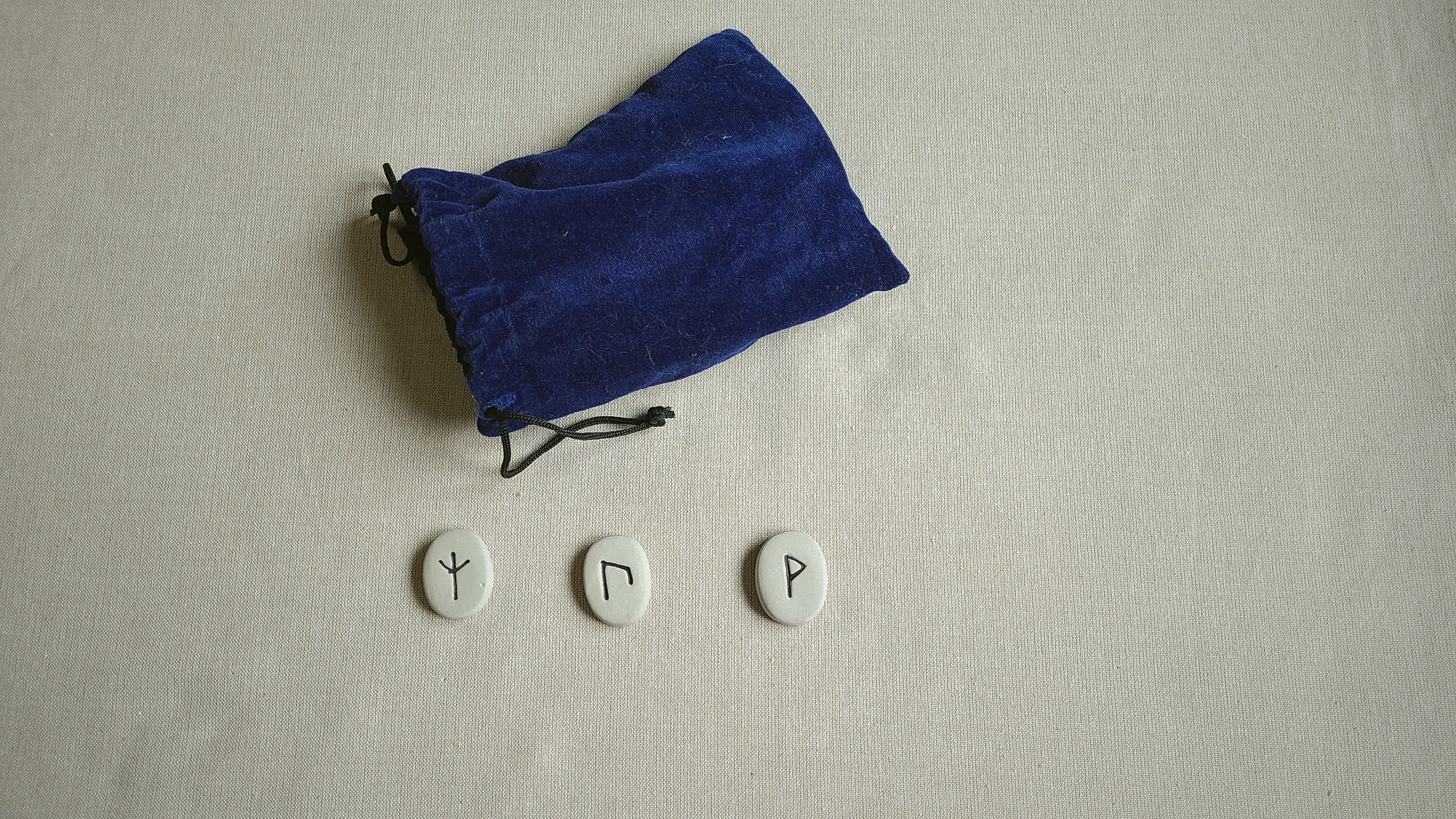
Three runes, laid left to right, is the working standard. Read them as three seats: what is beneath the situation, what is moving in it now, and what it is asking of you.
Set them down in draw order, a hand-width apart, and do not straighten a rune that lands crooked or reversed. How it lands is part of the answer.
Larger casts exist, but a beginner learns more from thirty three-rune readings than from one nine-rune spread.
Reversed runes, explained properly
Sixteen of the 24 runes read differently upside down; eight are symmetrical or read one way only. A reversed rune (some readers say merkstave) is not doom. It is the same energy blocked, inverted, or working against the grain.
The pattern holds across the whole alphabet. Two examples:
| Rune | Upright | Reversed |
|---|---|---|
| Fehu | Resources flowing | The flow has stopped, or you are gripping it |
| Ansuz | A message arriving | The message is garbled, or being ignored |
Reversal points at where the force is stuck, which is usually the most useful information on the table.
If a symmetrical rune like Isa or Hagalaz turns up, there is no reversed reading to look for. Ice is ice from any angle.
A worked example, start to finish
Say the question is: what is under my hesitation about moving cities? Three runes come out, in order:
Othala, reversed. Isa. Dagaz.
Beneath the situation: Othala reversed. Othala is inheritance: home ground, what gets passed down. Reversed, it suggests the hesitation is not really about the new city.
Something older is holding: a family pattern about staying put, a loyalty nobody ever said out loud.
Moving in it now: Isa, ice. A standstill. Not failure, a pause.
The situation is frozen and forcing it now would crack something. Isa in the middle seat often means the delay itself is doing work.
What it asks: Dagaz, dawn. The breakthrough rune, the turn from night to day. Read with the other two, it does not promise the move goes well.
It suggests a thaw is on its way, and when a thaw like that lands, the shift tends to go more cleanly, provided the old loyalty gets looked at rather than dragged along.
One reading, three stones. Notice what it did not do: it never said go or stay.
It named what the staying is made of. That is a rune reading working correctly.
When the runes seem to contradict each other
They will. A draw of Wunjo (joy) next to Nauthiz (need) is not a broken reading; it is a precise one. Read contradiction as tension in the situation, because there is tension in the situation, or you would not be consulting an oracle about it.
The seats resolve most conflicts: joy underneath, constraint on top reads very differently from constraint underneath, joy on top.
If a draw truly will not speak, put the runes back and stop. Not every hour is a reading hour, and forcing a second draw on the same question teaches you to stop trusting the first.
Do you need to cleanse or charge your runes?
Traditions vary and none of them are wrong, but here is our honest take: the practices that matter are the ones that mark the runes as set apart in your own attention. A bag they live in, a cloth they land on, a moment of quiet before you draw.
Moonlight is optional. Attention is not.
Questions people ask
Can I make my own rune set? Yes, and it is a genuinely good way to learn the alphabet. Wood discs and a marker are enough. The set does not need to be beautiful; it needs to be yours.
How many runes do you pull? One for a focused question, three as the working standard. More positions add nuance, not accuracy.
Can runes answer yes or no? They can, grudgingly.
| Rune | Leans |
|---|---|
| Sowilo | Yes |
| Hagalaz | No |
But you are paying for a conversation and asking for a coin flip. Ask a better question and the runes get better with you.
Do runes actually work? They will not predict Tuesday. What a draw reliably does is surface the part of your own situation you have been walking past, and there is nothing supernatural about how useful that is.
Where a draw becomes a reading
In a full Chart & Deck reading, the runes are one voice of several. Your birth chart holds the foundation and the cards map the situation; the runes take the seat they do best, the hidden forces underneath.
If the question you brought to this page keeps coming back, that is usually the sign it deserves the full table. The Inner Compass reading is built for exactly that, and your free Essence chart is the place to start.