Rune Meanings: The 24 Elder Futhark Runes
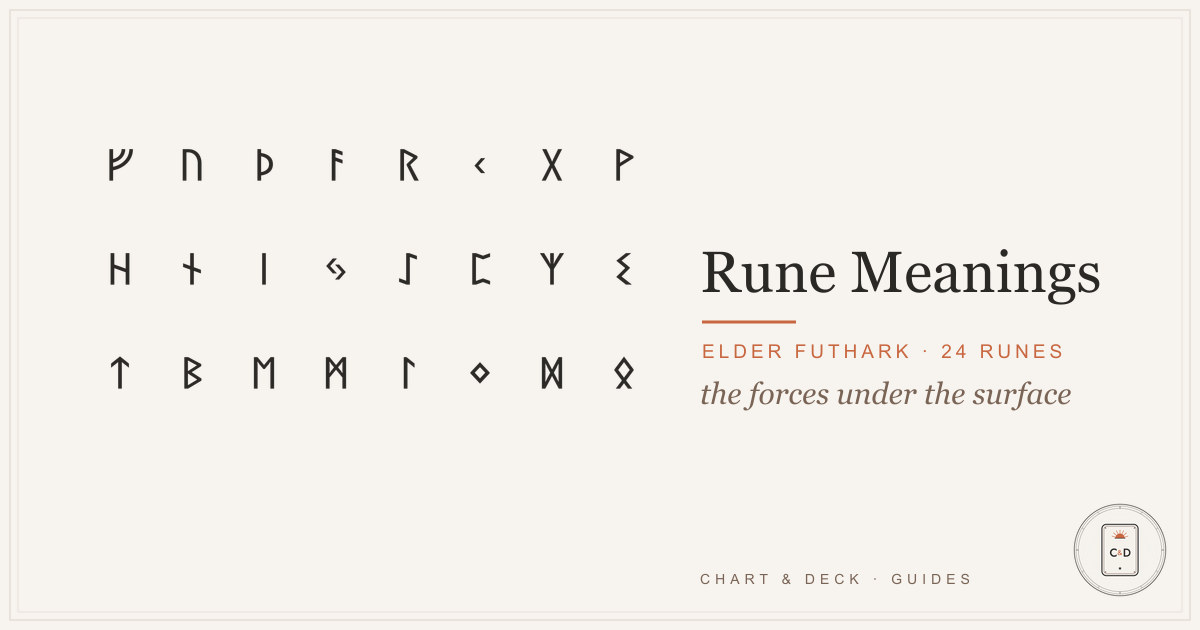
Rune meanings start with the alphabet they come from. The Elder Futhark is the oldest Germanic alphabet, and each letter carries a meaning older than its use in divination: cattle, ice, harvest, a torch, a gift.
Read as an oracle, the 24 runes name forces at work under a situation. This page holds all of them in one place, upright and reversed, with the plain history most guides skip.
On this page
This is what it feels like
One of them is already working on you
He came to clear his father’s workshop for an afternoon, three weeks after the funeral. He was still coming back a month later, one drawer at a time.
Every drawer was a decision. The chisels, he kept. The lathe, he photographed for the listing.
The broken spirit level he almost put in the sell pile, until his sister called and asked for it by name. Not the good one, still in its case. The broken one.
He was down to the last corner of the bench when he saw it.
Under the bench, wedged behind a coffee can of screws, he found a cigar tin with his own name on the lid, in his father’s block capitals. Inside: a spark plug, a fishing license from 1989, a two-dollar bill folded twice. No note.
He sat on the stool a long time, the tin open on his knee. The shop smelled the way it always had, oil and old sawdust, undisturbed under everything he had already boxed up.
His wife called to ask if he was coming home for dinner. He said yes. He did not move for another hour, sitting in the light going gold through the one window, not sorting anything.
On the way out, he did not take the good level. He took the broken one.
That pull, the one that does not show up in the spreadsheet of keep and sell, is what this alphabet is for. Not the future. The forces already in the room.
What the Elder Futhark actually is
The Elder Futhark is the oldest runic alphabet: 24 characters used across the Germanic world from roughly the 2nd to the 8th century, named for its first six letters (F, U, Th, A, R, K). The runes were a writing system first, carved into stone, bone, and wood, and each letter also carried a name and an idea: Fehu is “cattle,” which meant wealth; Isa is “ice”; Jera is “harvest.”
Tradition arranges them in three rows of eight, called aetts. The first aett opens with the workable world: wealth, strength, speech, craft.
The second passes through disruption and constraint into protection and light. The third belongs to the human world: justice, partnership, home, and dawn.
Two honest notes before the table, because they are exactly what most rune pages will not tell you:
The divinatory meanings are a modern practice built on old material. The rune names and their base ideas are historically attested. The practice of reading them as an oracle, as we do now, took its modern shape in the last century.
Tacitus describes Germanic lot-casting in the 1st century, so the impulse is ancient, but no Viking left us a manual. We treat the meanings as a working symbolic language, not an unbroken ancient science, and they hold up fine on those terms.
There is no blank rune. If your set has a 25th, blank stone, it comes from a 1982 book by Ralph Blum, not from any historical futhark.
We do not read it, and this guide does not include it. An alphabet does not need a letter for silence.
All 24 runes at a glance
Each rune links to its full page. Reversed meanings apply only to the 16 runes that read differently upside down; eight are symmetrical or otherwise read one way only.
| Rune | Symbol | Translation | Core meaning | Reversed |
|---|---|---|---|---|
| Fehu | ᚠ | cattle, wealth | Resources in motion; prosperity held lightly | Stagnation, clutching, misplaced value |
| Uruz | ᚢ | wild ox | Raw vitality and endurance | Force misdirected, strength gone stale |
| Thurisaz | ᚦ | giant, thorn | The thorn that defends; necessary confrontation | Recklessness, acting before thinking |
| Ansuz | ᚨ | god, mouth | A message, counsel, insight through language | Miscommunication, advice ignored |
| Raidho | ᚱ | ride, journey | Right movement, being in rhythm with events | Wrong pace, detour, out of step |
| Kenaz | ᚲ | torch | Skill and knowledge that light the way | False clarity, burnout, a block |
| Gebo | ᚷ | gift | Exchange, partnership, the tie a gift creates | (does not reverse) |
| Wunjo | ᚹ | joy | Earned gladness, harmony, belonging | Hollow cheer, joy out of reach |
| Hagalaz | ᚺ | hail | Disruption beyond control that also clears | (does not reverse) |
| Nauthiz | ᚾ | need | Constraint that teaches through friction | Self-imposed scarcity, resisting the lesson |
| Isa | ᛁ | ice | Standstill; patience while things hold | (does not reverse) |
| Jera | ᛃ | year, harvest | Results in their own season | (does not reverse) |
| Eihwaz | ᛇ | yew tree | Endurance, the spine that holds | (does not reverse) |
| Perthro | ᛈ | lot-cup | Chance, mystery, what stays hidden | Secrets working against you, fate forced |
| Algiz | ᛉ | elk, protection | Protection; instincts that guard the path | Warnings ignored, the guard lowered |
| Sowilo | ᛊ | sun | Success, vitality, light finding its way | (does not reverse) |
| Tiwaz | ᛏ | the god Tyr | Justice, courage, integrity at a cost | An unfair fight, conviction draining |
| Berkano | ᛒ | birch | New growth and the care it needs | A stalled or troubled start |
| Ehwaz | ᛖ | horse | Trusted partnership, moving as one | Mistrust, a pace betrayed |
| Mannaz | ᛗ | human | Self-knowledge, one’s place among others | Self-deception, isolation |
| Laguz | ᛚ | water | Intuition, the current beneath the surface | Overwhelm, murky judgment |
| Ingwaz | ᛜ | the god Ing | Potential ripened, ready for release | (does not reverse) |
| Dagaz | ᛞ | day, dawn | Breakthrough; the turn from night to day | (does not reverse) |
| Othala | ᛟ | inheritance, homeland | What is kept and passed on; roots | Clinging to the past, an unexamined pattern |
What reversed actually means
When a drawn rune lands upside down, readers call it reversed, or merkstave. It is not the meaning turned evil. It is the same force blocked, inverted, or working against the grain: Fehu’s flow becomes clutching, Ansuz’s message becomes noise.
Eight runes read one way only, either because the shape is symmetrical or because the force does not have a workable opposite. Hail is hail from any angle.
How runes differ from tarot
In our readings the two do different jobs. The cards map the situation you are standing in. The runes surface the hidden forces underneath it, the currents you feel but have not named, like the pull toward the broken level.
That is why a rune draw so often lands as recognition rather than news. If you want the mechanics of an actual draw, the casting guide walks through it: how to read runes.
Questions people ask
How many runes are there? The Elder Futhark has 24. Later futharks differ (the Younger Futhark has 16), but 24 is the divination standard.
What is the difference between Elder and Younger Futhark? The Elder Futhark is the older, fuller alphabet. The Younger is a pared-down 16-rune version that emerged in the Viking Age for writing Old Norse. Readings use the Elder set.
Are rune meanings historically accurate? The names and base ideas are attested; the divination system is modern. We say so plainly, because a practice honest about its history is more useful, not less.
Do runes predict the future? No, and we would not trust them more if they claimed to. They name tendencies and forces already in play. What you do with that stays yours.
Which rune means love? Money? Protection? Gebo for the bond, Fehu for resources, Algiz for protection, roughly. But a single rune out of context is a word, not a sentence. The draw around it matters.
When a question deserves more than a single rune
A rune draw is one voice. In a full Chart & Deck reading it joins your birth chart and the cards, and the runes take a specific seat at that table: the hidden forces under your question, the part of the story you feel but have not said out loud.
If something in you has been circling a question like that, the Inner Compass reading is where we listen properly. Or start free: your Essence chart is the foundation everything else reads against.