
Ten of Swords Meaning
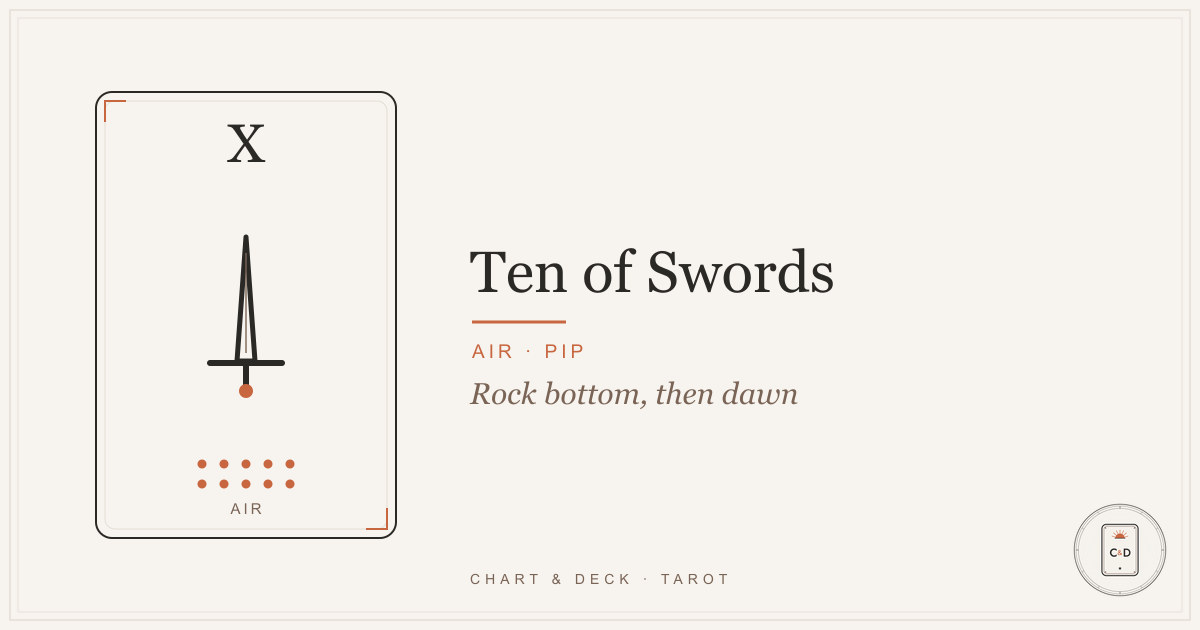
The Ten of Swords meaning is rock bottom: an ending so complete there’s nothing left to argue with, paired with a dawn that says the worst is already over. Upright, it’s the final blow landing. Reversed, it’s the slow climb out that starts right after.
“That’s a wrap.” Bram says it to no one, the house lights already up and unglamorous, and nobody answers because the last of the crew went out the stage door twenty minutes ago. He’s still holding the props list, half the items crossed off in his own hand. Behind him, two riggers pull flats off their braces, and each one comes down with a sound like a held breath let go.
The house strips to the bones faster than it was ever built. Cable coils get looped over a shoulder and carried out. A grip works the pin on a batten and the black masking drops in a heap of dust. Someone left a ghost light in the wings but hasn’t switched it on yet, so the only real light is coming through the open loading door at the back, gray going to gold, the alley outside just starting to catch it. Bram sets the props list down on an empty road case. He doesn’t pick it back up.
The last flat comes down. A rigger calls something to the other, laughs once, and their footsteps head for the door, and then it’s only Bram, the empty grid overhead, the shape of a stage that isn’t a stage anymore, just a room with a floor painted black. He walks past the coiled cable and the case with his list on it, and stands in the loading door’s frame, where the light is strongest, where the alley outside is turning the color of something that hasn’t happened yet.
On this page
What the Ten of Swords means
Ten is full culmination in any suit, the arc carried all the way to its end, and in the suit of the mind that ending doesn’t ease in. The card shows a figure face down, ten swords driven into the back, no ambiguity left about what happened. It’s the single heaviest image in the deck.
But the traditional card doesn’t stop at the body. Behind the figure, the sky is breaking into dawn, gold spreading low along the horizon. That detail is the actual point: this is as bad as it gets, which means what comes next can only be recovery. Nothing worse is coming. The worst already arrived.
Upright, expect the full weight of that: betrayal, a definitive ending, a chapter that’s unmistakably closed, whether you wanted it closed or not. It doesn’t ask you to see the bright side yet. It states, plainly, that this is the bottom.
| Position | Keywords |
|---|---|
| Upright | ending, betrayal, rock bottom, painful conclusion, release, a difficult chapter closing |
| Reversed | recovery beginning, resisting an ending, the worst is over, slow healing, surviving the worst |
Reversed, the swords are still there, but the body is starting to stir. This reading leans two ways depending on where you are: either recovery has already begun, the slow unglamorous work of standing back up, or you’re the one still refusing to admit the ending happened, holding on to a thing that’s already over because letting go feels like one more loss. Either way, the card’s core claim hasn’t changed. The worst has already happened. What’s left is what you do with the dawn.
The Full Natal Reading · $19 · your chart, then your card
Worth knowing: a card’s meaning is generic until it’s mapped to your chart.
What you just read about the Ten of Swords is true for anyone who draws it — that’s what a symbol is, the same for everyone. What isn’t generic is the chart underneath it: the planets, the houses, the wiring that decides which parts of a symbol are actually live in your life. The Full Natal Reading maps all of that in plain language, then you pull a card by hand and it’s read against your map, as one portrait of you. In your inbox in minutes.
Read your chart, then your card — $19 →Your $19 comes off a full personal reading later, if you go further.
The Ten of Swords in love
In love, this tends to mark a definitive ending: a breakup that isn’t ambiguous, or the last blow to something that was already failing under its own weight before this card showed up to name it. It rarely describes a rough patch. It describes the patch after the rough patch, when the thing is actually finished.
Upright, let it be as final as it looks; there’s often relief in that, even before it feels like relief. Reversed, you’re either past the worst of the grief and starting to rebuild, or still refusing to admit the relationship already ended.
The Ten of Swords in career
At work, this is the rock-bottom card: a job loss, a project that collapses completely, a professional chapter that closes without ceremony. It doesn’t hedge. Something ended, and pretending otherwise usually costs more than accepting it.
Reversed, you’re on the other side of that collapse, however recently: a new application sent, a first small step back into the field, early proof that this ending wasn’t the end of you, just the end of that particular chapter.
The Ten of Swords yes or no
| Question | Answer |
|---|---|
| Yes or no? | No, but paired with the promise this is the end of the bad stretch, not the start of one |
| Timing | The ending has already happened, or is happening now |
| What it asks of you | Let the bottom be the bottom, so the climb can actually start |
This card rarely hedges. Upright, it’s a clear no, the kind that closes a door rather than leaving it ajar. Reversed, the question shifts from whether something is ending to how far along the recovery already is.
Common questions about the Ten of Swords
Does the Ten of Swords mean death? No, not literally. It almost always points to an ending: a relationship, a job, a version of a situation you’d been holding onto, not a literal death. The dawn in the image is the real message: nothing worse is coming after this.
What does the Ten of Swords mean for a breakup? A clean, final one, or the last blow to a relationship that had already been failing under its own weight. Reversed, you are either well into recovering from it or still refusing to admit it is over.
What does the Ten of Swords reversed mean? The slow climb that starts right after rock bottom: the worst has already happened, and what’s left is standing back up, one unglamorous day at a time.
When an ending needs more than a card
A single card can name that something is over. It can’t tell you what closes next, or what the dawn behind you is actually pointing toward once you’re back on your feet.
If an ending is sitting heavier than a quick read can hold, or you’re standing at the edge of whatever comes after it, see the readings, built around Life Direction and Purpose and read against your actual chart and situation, not a page written for everyone. Or start with your free natal chart reading if you want a lower-key first look.
For the rest of the suit, the Swords hub covers how truth and conflict move through every card, sitting between Nine of Swords, the sleepless night before the ending lands, and Page of Swords, the restless curiosity that starts a new chapter once this one is closed. For the full deck, start at tarot card meanings.
The Full Natal Reading · $19 · your chart, then your card
That meaning above is generic. Your birth chart is the map that makes any card mean something specific.
What you just read about the Ten of Swords is true for anyone who draws it — that’s what a symbol is, the same for everyone. What isn’t generic is the chart underneath it: the planets, the houses, the wiring that decides which parts of a symbol are actually live in your life. The Full Natal Reading maps all of that in plain language, then you pull a card by hand and it’s read against your map, as one portrait of you. In your inbox in minutes.
Read your chart, then your card — $19 →Your $19 comes off a full personal reading later, if you go further.