
How Does Tarot Work? What a Reading Actually Does
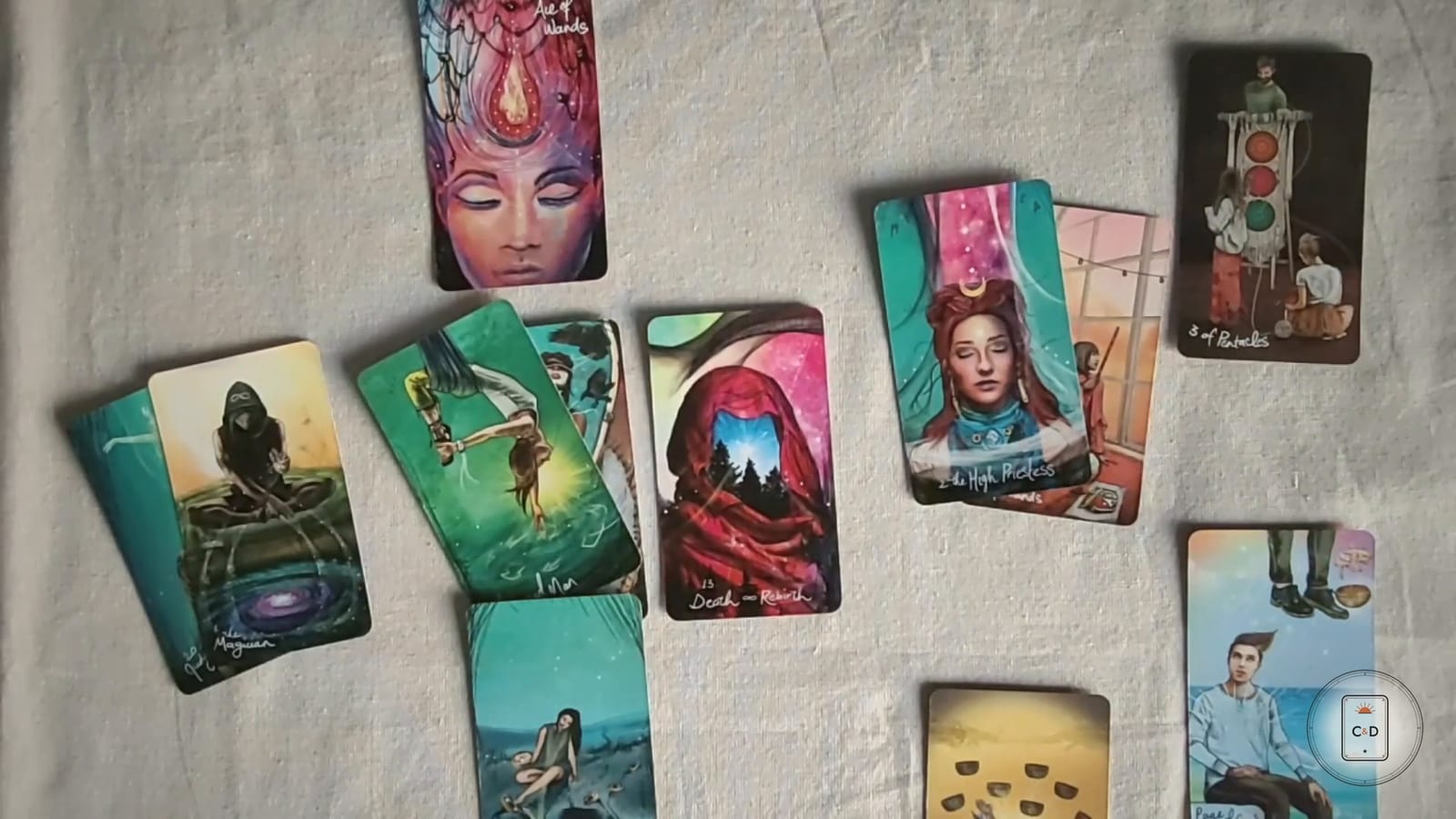
Most people who have had a tarot reading do not mention it at work.
Not because it did nothing. Because of what saying it out loud seems to claim: that you believe a stranger can see your future in a deck of seventy-eight cards.
That is a reasonable thing to be embarrassed by. It is also not what happened.
The question worth asking is not whether you were fooled. It is this: how does tarot work, if nobody is predicting anything?
Short version, before the evidence. A random image forces you to say something out loud that you already knew and had been carefully not saying. Everything below is that claim taken apart: the mechanism, the research that exists, the research that does not, and what Jung actually put on the record in 1933.
On this page
The problem was never the cards
The objection is not the cardboard. It is the claim attached to it: that someone shuffles, turns something over, and tells you what will occur. Strip that claim away and what is left is a person looking at a random image and saying what they see in it.
Ask a sceptic what bothers them and they will point at the deck. It is almost never the deck.
A prediction made with no way to check it, usually for money, is worth refusing. Scepticism there is not closed-mindedness. It is basic hygiene.
We do not make that claim, and this page is partly the record of why.
So look instead at what is physically happening at the table.
A person draws an image they did not choose. They look at it, and they say what it has to do with the thing they walked in carrying.
Nothing supernatural has been asserted yet. And something quite specific has already started.
What actually happens when a card turns over
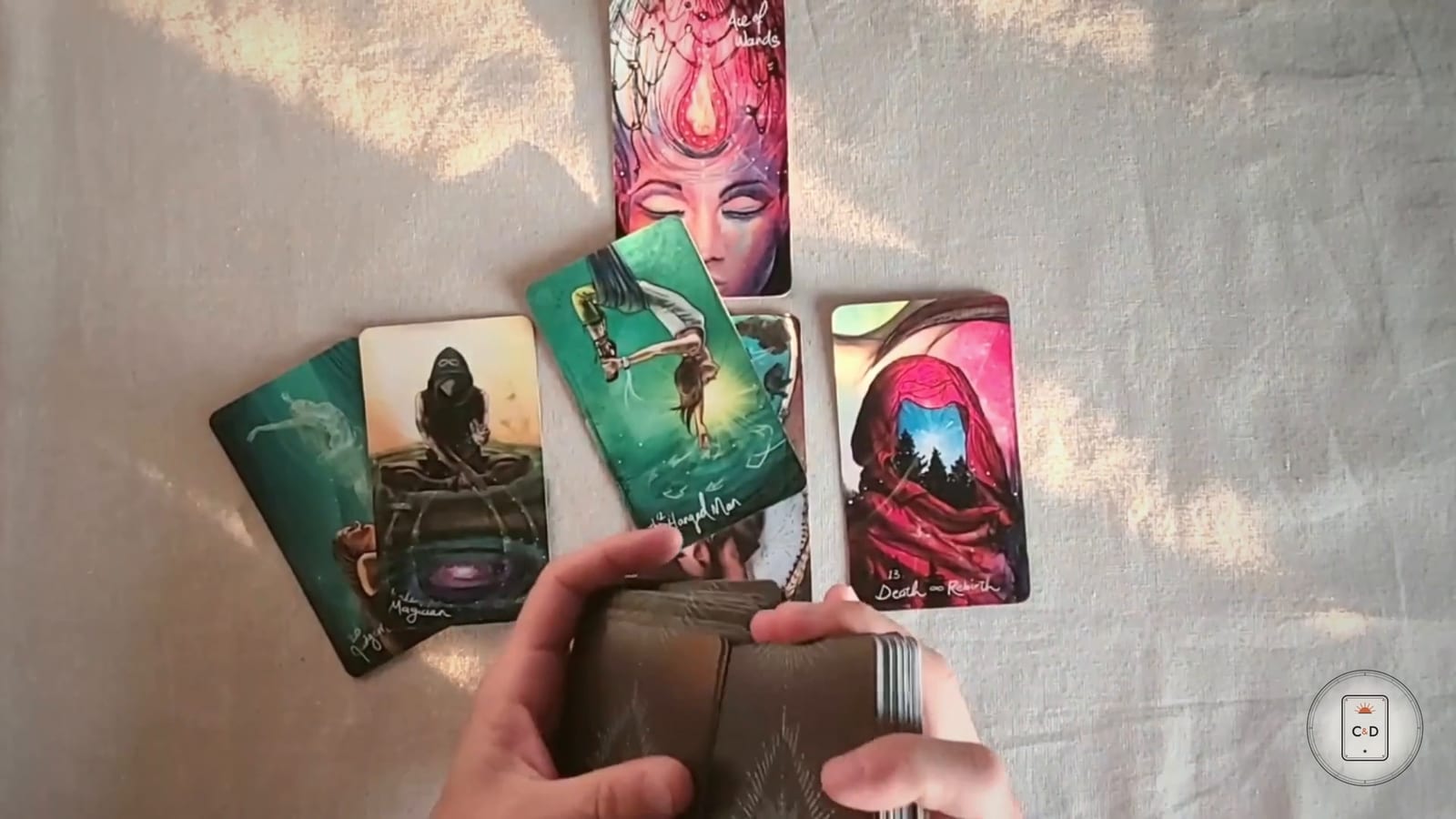
Here is the mechanism, with nothing mystical in it. You are handed an image you did not choose, full of figures and weather and gesture, and asked what it has to do with your situation. Your mind builds the bridge automatically, and it builds it out of your own material.
You cannot not answer. Give the mind two unrelated things and it will find the connection, because that is what it does with everything.
Say the card is the Eight of Cups: a cloaked figure walking off at night, away from eight cups he stacked himself. Nobody has told you what you are walking away from. By the time you finish the sentence, you have.
The connection you build is made of your material, not the card’s. The image supplies a prompt. You supply the meaning, the specifics, the person you were thinking about before you sat down.
So the card does not know anything about your life. You do. What the card does is make you say it.
That sounds small. Sit with someone at a table and watch it land and it is not small at all, because the thing people put into words is almost never new information. It is something they already knew and had been carefully not saying.
Which raises the obvious objection. If the prompt is random, why not just use a random word?
Consultants do this too. They call it something else.
Because someone already tried the random word, and it is still standard practice in corporate strategy rooms. Edward de Bono published the technique in 1970 and called it random entry: when your thinking has worn a groove, introduce a deliberately unrelated word or image and force a connection to it.
The point was never that the random word contains wisdom. It is that your thinking has worn a groove you cannot see from inside it, and an unrelated prompt is the cheapest way out.
Now compare the two prompt sets. A word pulled from a dictionary, against seventy-eight images refined over five centuries, carrying most of the situations a human life contains: loss, ambition, waiting, betrayal, the thing you will not look at.
One of those is a considerably richer instrument, and no belief is required to see which.
There is a fair next question in that. If the mechanism is that ordinary, has anyone actually tested it?
What the evidence supports, and what it does not
The mechanism is defensible. The outcome is not evidenced. That gap is the real answer to “is tarot accurate,” and saying it costs us something, so we will pay it.
There is no controlled evidence that a tarot reading improves an outcome. No trial shows people who had a reading making better decisions than people who did not. If anyone tells you otherwise, ask for the study.
What does exist is narrower and real.
Arthur Rosengarten, a clinical psychologist in practice for more than thirty years, wrote the first accredited doctoral dissertation on tarot in 1985, comparing it experimentally against dream interpretation and projective storytelling. His book Tarot and Psychology: Spectrums of Possibility (Paragon House, 2000) is the closest thing the field has to rigorous treatment.
Inna Semetsky, working in philosophy of education, has published empirical research framing tarot as a counselling and teaching instrument rather than a divinatory one, collected in Re-Symbolization of the Self (2011).
Sallie Nichols wrote Jung and Tarot in 1980, still the clearest reading of the Major Arcana as a map of psychological development.
That is a small body of work, and we would rather say so than inflate it. The defensible claim is about mechanism, not outcome: a structured random image reliably prompts a person to articulate something they already knew and had not said. That claim is testable in the room, and it needs no supernatural premise at all.
That leaves one more source. The one everyone cites and almost nobody checks.
What Jung actually said about tarot
Jung is quoted on tarot constantly, and most of those quotes are invented. He discussed it once on the record, and he did not say the cards predict anything. He said they are something the psyche plays with.
Search for one of the famous lines and you will find it attributed everywhere and sourced nowhere. So here is the primary source instead.
On 1 March 1933, in a seminar on active imagination, he described the cards this way:
They are psychological images, symbols with which one plays, as the unconscious seems to play with its contents.
That is from Visions: Notes of the Seminar Given in 1930-1934, published by Princeton University Press in 1997. He also called the images “distantly descended from the archetypes of transformation,” and grouped tarot with the I Ching and astrology as intuitive methods.
Note what he does not say. Not that the cards predict. That they are something the psyche plays with, the way it plays with a dream.
That way of reading the deck has a name. It also has an address.
Taught in London since 1983
This is not a new idea we are proposing. Reading the deck as psychological material rather than prophecy is what people mean by Jungian tarot, and it has been taught by analysts with clinical credentials, in one London institution, for over forty years.
Liz Greene is a Jungian analyst who co-founded the Centre for Psychological Astrology in London in 1983, on a single premise: a birth chart is psychological material, not a forecast. With Juliet Sharman-Burke, a qualified analytic psychotherapist, she created The Mythic Tarot in 1986, reading the deck through myth and depth psychology rather than divination.
Sharman-Burke has taught and supervised there since the Centre opened. She now teaches the tarot certificate at Jung Platform, which runs its Jungian coaching certificates alongside it.
Greene has been in our own bibliography from the start, for exactly this reason. You can see who reads here, and what they read.
So the approach is not fringe. It is simply not the version of tarot that gets a television show.
And there is a quieter piece of evidence sitting next to it. Image decks like OH Cards and Points of You are used in professional coaching, in psychotherapy, in clinical supervision and in corporate workshops.
The mechanism is identical. A card is drawn at random, the person projects onto the image, and whoever is running the session works with whatever they say about it.
Remove the divinatory framing and the same practice is billable consulting.
Which suggests the objection was never really about the cards after all.
So what is a reading actually for?
If a reading cannot tell you what will happen, it is for the thing you have been circling. The decision you keep re-opening, the pattern you can see the shape of but cannot name, the question you have not said out loud in the words you actually mean.
A chart is a blueprint. It shows the shape of a house and the rooms you are meant to live in, and it does not script a single step you take inside them.
The cards read where you are standing in it right now.
We speak in tendencies, never certainties. Nobody here will name a date, and nobody will tell you an outcome is settled, because it is not. The future is not fixed, and your choices are the whole point of having one.
| What a reading does | What it does not do |
|---|---|
| — | — |
| Hands you an image you did not choose and asks what it has to do with your situation | Tells you what is going to happen |
| Makes you put words to the thing you have been circling | Names a date, or calls an outcome settled |
| Reads the whole spread against your chart and your real question | Scores itself against a future it claimed |
| Leaves the decision, and the consequence, with you | Stands in for therapy, or for medical, legal or financial advice |
Every page in the guides is written to that standard: the mechanism first, and the limit named out loud.
If a question like that has been sitting with you, the free natal chart reading is the place to start. It takes about a minute, it costs nothing, and it will show you your own chart with a short written portrait and the questions worth asking about your path.
When one of those questions turns out to be the one where you are stuck between two paths, that is what a full personal reading is for. How a reading is actually made, from the filmed pull to the finished document, is written up separately.
And the next time it comes up at work, you have a sentence for it that is true. Nobody told you your future. A random image made you say the thing you already knew.
Common questions
How does tarot work? You are handed an image you did not choose and asked what it has to do with your situation. Your mind builds that connection out of your own material, so what comes out of your mouth is yours, not the card’s. The card knows nothing about your life, and what it actually does is make you say what you already know.
Is tarot real? The cards are real and the mechanism is real. A random image reliably prompts you to articulate something you already knew. What is not real is the claim that the cards know your future, and we do not make it.
Is tarot accurate? Accuracy is the wrong measure, because a reading is not making a prediction that could later be scored. The useful question is whether it surfaced something true about where you are, which you are in a better position to judge than anyone.
Do I have to believe in anything for a reading to work? No. The mechanism described above needs no supernatural premise. Plenty of people arrive sceptical and stay sceptical about the metaphysics while still finding the hour useful.
Is this the same as therapy? No, and we will not pretend otherwise. A reading is reflective guidance, not treatment, and it is not a substitute for medical, psychological, legal, or financial advice.
<!–